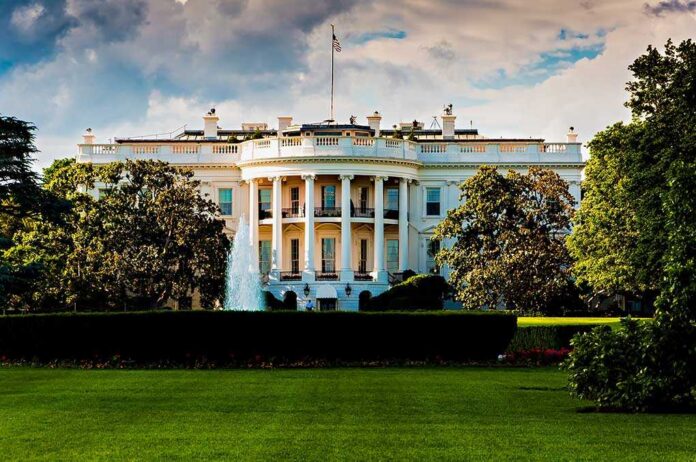
A hidden camera inside the White House just caught a budget analyst calling the president “a madman” — and the fallout landed faster than the tape could cool.
Story Snapshot
- James O’Keefe released undercover footage of White House budget analyst Benjamin Elliston allegedly calling Trump “a mess” and saying “we’ve gotta get rid of him.”
- The White House placed Elliston on administrative leave after the video’s release and confirmed he had no direct access to the president or senior staff.
- A second staffer, Maxim Lott, also appeared in the footage but publicly defended himself, saying nothing he said contradicted the administration’s agenda.
- Federal workers caught in previous O’Keefe stings have sued, alleging secret recordings were selectively edited to manufacture a false impression of disloyalty.
What the O’Keefe Video Actually Shows
James O’Keefe’s O’Keefe Media Group released what it calls “The White House Tapes,” an undercover sting featuring two White House staffers making candid remarks about President Trump [5]. Benjamin Elliston, identified as a budget analyst manager, allegedly described Trump as “a mess,” called him “erratic,” and made remarks that observers interpreted as calling for his removal [8]. The video racked up hundreds of thousands of views within hours of publication, reigniting the “deep state” debate that has shadowed Trump’s presidency since day one [6].
A second staffer, Maxim Lott, also appeared in the footage. Unlike Elliston, Lott went on record after the release and stated that nothing he said contradicted the Trump administration’s positions, and that he remains fully committed to the president’s agenda [4]. That distinction matters. Two people caught on the same hidden camera responded in completely opposite ways, and only one of them ended up on administrative leave.
The White House Response Tells Its Own Story
The administration did not dismiss the video. A White House official told the Daily Caller that Elliston “has no direct access to the President or Senior Staff” and that his remarks did not reflect the administration’s views [4]. Elliston was placed on administrative leave shortly after [4]. That is a meaningful institutional response. You do not put someone on leave for a video you believe is fabricated. The action itself signals that someone inside the building took the content seriously enough to act on it.
The official distancing — “no direct access to the president” — is also worth reading carefully. It is a damage-control statement, not a denial that the remarks were made. It concedes the remarks happened while minimizing their operational significance. That is a narrower defense than it first appears, and it leaves the core of O’Keefe’s narrative largely intact.
Where O’Keefe’s Methods Create Genuine Uncertainty
O’Keefe’s track record is a double-edged sword. His “Dating the Deep State” series previously captured federal workers and Pentagon-linked contractors making anti-Trump remarks, leading to firings and administrative actions in multiple cases [3]. The pattern lends credibility to the idea that genuine anti-Trump sentiment exists inside the federal workforce. But former Federal Bureau of Investigation (FBI) agent Jamie Mannina is currently suing O’Keefe, alleging that conversations were edited and spliced to create a false impression of an attempted coup [2]. That lawsuit does not prove Elliston’s video was manipulated, but it is a live legal argument that identical methods were used deceptively in a parallel case.
No verbatim, independently verified transcript of Elliston’s specific remarks has been released publicly [1]. No forensic video analysis has been published. No unedited raw footage has been made available. Those gaps do not exonerate Elliston, but they do mean the strongest version of the “sabotage” framing — that a White House staffer was actively working to undermine the president — remains inferential rather than documented [1]. Private frustration, even expressed in colorful terms, is not the same as operational obstruction, and conflating the two serves a narrative more than it serves the facts.
What This Episode Actually Reveals About the Federal Workforce
The more durable takeaway here is not about Elliston specifically. It is about the broader reality that career federal employees, political appointees, and contractors cycle through administrations with their own views intact. O’Keefe’s operations have now produced enough similar footage across enough different agencies to establish a pattern [3]. The “deep state” framing is politically loaded, but the underlying phenomenon — that some federal workers hold views hostile to the sitting president and occasionally say so — is not a conspiracy theory. It is a management problem with real consequences for policy execution, and the Elliston episode is one more data point in that ongoing story.
Sources:
[1] Web – Undercover Video Shows White House Staffer Criticizing Trump
[2] Web – Ex-FBI Agent Sues Over Secret Recording Showing Him Criticizing …
[3] Web – Federal workers sue over sting operations by political provocateur …
[4] YouTube – James O’Keefe Asks Pentagon Press Secretary Question …
[5] Web – Who Are Maxim Lott and Benjamin Ellisten? White House Staffers …
[6] YouTube – O’KEEFE EXPOSE: The White House Tapes
[8] YouTube – BREAKING! White House Employee CAUGHT In Undercover Sting …