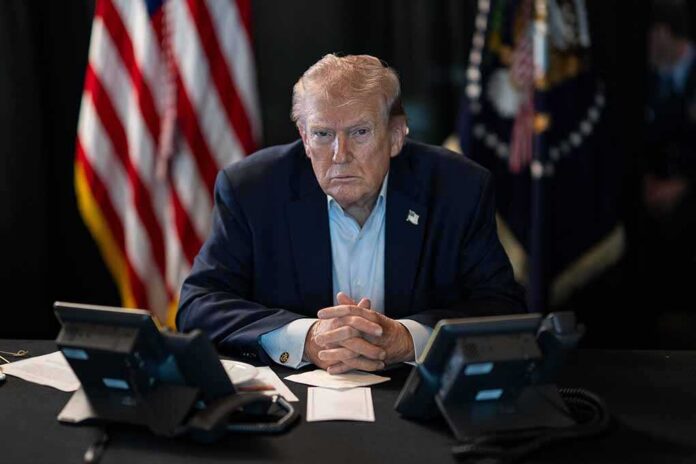
Trump said his deportation push “was too tough,” and he tied it to a political price.
Story Snapshot
- Trump said his deportation policy “was too tough” in a 60 Minutes interview.
- He linked that stance to midterm losses, saying, “Ultimately, that hurt me”.
- He praised removing criminals while saying workers with jobs also got swept up.
- No formal policy reversal followed from the interview remarks so far.
What Trump Admitted On Air
President Trump told CBS’s 60 Minutes that his deportation policy “was too tough,” and he repeated, “it might be too tough.” He said the effort removed people who held steady jobs, paid some taxes, and had only the single offense of illegal entry. He gave examples such as workers in landscaping and hotels. He also said he received strong support for removing criminals, but he took a hit when enforcement pulled out nonviolent workers with roots in their towns.
Trump tied the issue to the midterm results. He said, “I think ultimately that hurt me,” a line that framed the policy not only as a question of border control, but also as a political cost. Bloomberg reported the exchange as a concession that broad removals likely damaged Republicans in key races after the election. That framing underscored a familiar tradeoff in immigration debates: tough talk wins points until enforcement touches people known in the community.
Who Was Caught In The Net
Trump’s comments singled out a specific group: people who worked, paid some taxes, and had no serious criminal convictions beyond unlawful entry. He said the crackdown reached employees at local businesses, including hotels and landscaping firms. That claim drew a line between “the bad ones” and long-settled workers. CBS summarized his view as pride in removing criminals paired with regret that other workers got removed and that the broader sweep cost him politically.
Published coverage from Newsweek tracked the same contrast. It reported Trump’s defense of strong border enforcement and his belief that deporting nonviolent, economically active workers undercut Republicans with some voters. The piece highlighted Trump’s on-air words and emphasized the political impact he described. It did not offer counts of affected workers or a breakdown by crime level, but it captured the policy-versus-politics tension he raised.
What The Election Angle Really Means
Trump put a clear cause-and-effect on the table: the deportation push helped with public safety marks and hurt in the midterms. That is an assertion from the principal himself. It should be weighed as his political judgment, not a full analytics study. The interview did not present precinct data or polling that isolates deportation as the deciding factor. Still, tying enforcement to electoral pain explains why any leader might refine tactics after a loss.
News organizations that covered the exchange also noted the lack of a formal policy change. There was no executive order, agency memo, or directive announced on the program. CNN’s takeaways stressed that Trump couched the point with qualifiers and described competing views among voters. That matters for expectations: a televised recalibration can shape priorities, but it is not the same as a signed change in operational rules.
How This Fits The Larger Pattern
The story sits inside a pattern that repeats across decades. Voters want the border secured and violent offenders removed. At the same time, many communities rely on long-term, nonviolent workers. When enforcement crosses from symbol to daily life, the costs grow visible. That tension explains why leaders praise strictness on crime but hesitate to remove people who hold jobs and pay taxes. Trump’s remarks mapped onto that line, almost point for point.
🚨 TRUMP ADMITS DEPORTATION CRACKDOWN MAY HAVE BEEN TOO TOUGH AFTER GOP MIDTERM LOSSES
President Donald Trump is reconsidering the political impact of his immigration enforcement strategy following Republicans’ loss of both chambers of Congress.
In a CBS “60 Minutes” interview,…
— MDBayNews (@MDBayNews) November 9, 2026
Economics research adds another layer for common-sense conservatives. Studies on past enforcement waves show mixed results. Some work finds wage bumps in low-wage markets but no clear gains in jobs for U.S.-born workers. Other research warns of broader losses if removals thin the workforce and disrupt sectors. That literature cannot prove what swung a given election, but it supports Trump’s instinct that blunt sweeps can backfire where employers and churches know the people affected.
Sources:
mediaite.com, cbsnews.com, abs-cbn.com, themirror.com, brookings.edu
© targetdailynews.com 2026. All rights reserved.