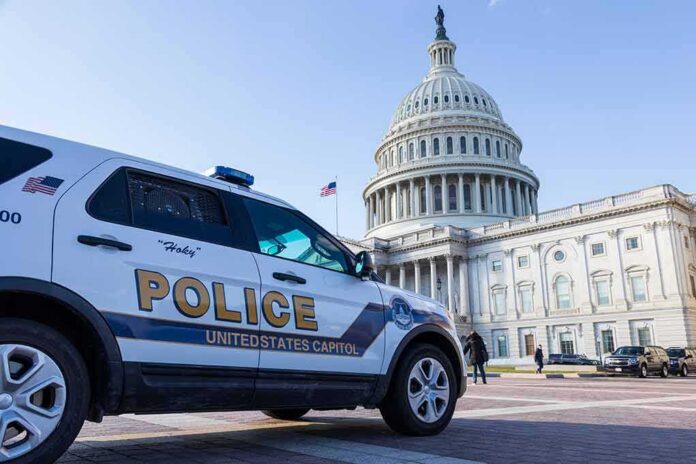
Secret Service officers say they stopped an armed, undocumented Venezuelan in a stolen car near the White House who allegedly said he came to kill President Trump.
Story Snapshot
- Officers arrested Ronny Yordrix Guanipa Chrinos on Constitution Avenue with three guns and ammo.
- The vehicle was reported stolen; charges include multiple gun and theft counts.
- Documents cited by outlets list a rifle, a machine-style pistol, and a Glock pistol.
- The suspect allegedly said voices told him to come to Washington and kill Trump.
What officers say they found and where they found it
United States Department of Homeland Security said Secret Service officers approached a parked vehicle on Constitution Avenue on the evening of November 5. They identified the driver as Ronny Yordrix Guanipa Chrinos, a Venezuelan national without legal status. Officers reported finding three firearms and dozens of rounds of ammunition in the vehicle and took him into custody near the White House complex. A court appearance followed, and reports said he remained held without bond soon after.
News accounts, citing court records, matched the gun list to a rifle and two handguns, including a compact Glock. Some reports described one weapon as a MAC-10 style machine pistol and another as an AR-15 rifle, which aligns with the official outline of three firearms recovered. The Department of Homeland Security release stated the vehicle itself had been reported stolen, a key fact that added two property crimes to the case.
The charges and what they mean in plain terms
Officials listed a dense stack of District of Columbia offenses. The list included carrying a rifle outside a home or business, multiple counts of unlawful transportation of a firearm, possessing unregistered firearms and ammunition, carrying a pistol without a license, possession of certain dangerous weapons, unauthorized use of a motor vehicle, theft, and receiving stolen property. Translated, that means prosecutors can argue he had guns he could not legally have, carried them where he could not, and sat in a car he did not lawfully control.
Media reports based on the initial court docket said he faced vehicle charges tied to the reported theft, along with the weapons counts. They noted an initial appearance in District of Columbia Superior Court and that he stayed in custody after that hearing. Coverage across major outlets confirmed the Secret Service arrest near the White House and the continuing detention while charges moved ahead.
The alleged threat against President Trump and why intent matters
The Department of Homeland Security release said the suspect allegedly told officers he heard voices that told him to come to Washington and kill President Trump. Several outlets repeated that claim and reported that threat language featured in the early case narrative. One sentence of caution belongs here: an arrest and a claimed statement do not equal a completed attack, and the charges filed center on guns and a stolen car, not an assault.
A suspect was arrested blocks from the White House Thursday, allegedly armed with three guns. He reportedly claimed voices told him to kill Trump. #WhiteHouse #Trumphttps://t.co/bLaRRntRO7
— The Informed Citizen (@informedbrief) November 8, 2026
From a conservative, common-sense view, the picture is plain. A man who is not legally in the country, in a stolen vehicle, parked near the White House with three guns and a pile of ammo, is a danger you do not shrug off. You do not need to wait for him to squeeze a trigger at a protected site to act. The law draws that line on purpose. Secret Service doctrine exists to stop the attempt before it starts, and that is what officers say they did here.
How this fits the hard lessons of presidential protection
Secret Service case studies show that violence near the White House can move fast. Past incidents include gunfire toward the building in 1994 and 2011, and a 2001 shooting near the south fence. Those cases prove why proximity plus weapons equals action. Threat assessment programs are built to spot, assess, and manage people who may pose harm and to intervene early—well before an approach to a door or a draw from a holster.
Sources:
pjmedia.com, dhs.gov, politico.com, edition.cnn.com, 10tv.com, secretservice.gov
© targetdailynews.com 2026. All rights reserved.