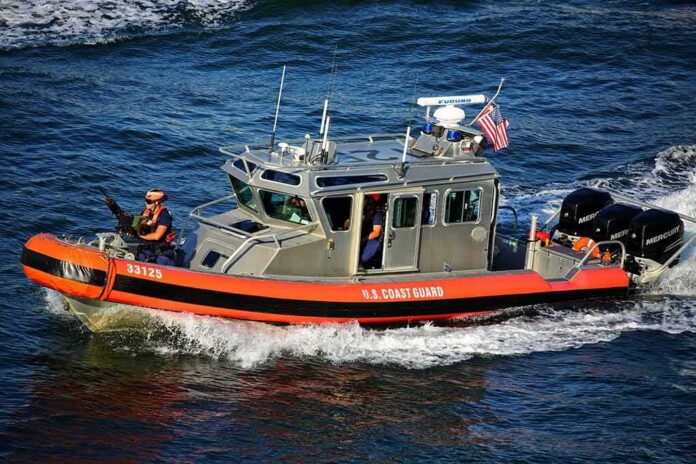
Seven thousand two hundred fifty pounds of cocaine never made it to American streets because a Coast Guard crew caught the smugglers in time.
Story Snapshot
- Coast Guard Cutter Richard Dixon intercepted a suspected smuggling boat near Puerto Rico on Aug. 22.
- Crews seized about 7,250 pounds of cocaine valued near $54.5 million.
- Air support from Customs and Border Protection helped track and stop the go-fast boat.
- The bust fits a steady pattern of big Caribbean seizures tied to Puerto Rico.
What The Coast Guard Stopped, Where, And How
U.S. Coast Guard Cutter Richard Dixon moved on a suspected smuggling boat about 50 miles off Puerto Rico on Saturday, Aug. 22. A Customs and Border Protection air unit guided the cutter to the target. Boarding teams found more than 7,000 pounds of cocaine on board. The estimated haul came to 7,250 pounds, with a wholesale value of about $54.5 million. Crews detained five people from the smuggling boat. The disabled boat was later destroyed for safety, according to reports.
The numbers jump off the page, but the operation followed a familiar script. Air assets spotted a go-fast vessel running light and low. The cutter closed the gap and launched a boarding team. The team secured the crew and searched the boat. Bales of cocaine packed the space. The crew logged the contraband, moved it to the cutter, and prepared for transfer to federal partners. This rhythm is standard in the Caribbean corridor when teams get there fast enough.
Why Puerto Rico’s Waters See Repeated Big Catches
Traffickers use the sea lanes north and south of Puerto Rico because the routes are short, busy, and close to U.S. territory. The Coast Guard and partners keep cutters, small boats, and air patrols in the area. That posture pays off in frequent seizures. Recent cases north of Puerto Rico show cocaine loads measured by the bale and by the ton, with named cutters offloading drugs and handing suspects to federal agents for prosecution.
Official releases describe the same playbook again and again. Crews disrupt a go-fast boat, seize bales, and transfer drugs and suspects to federal custody in San Juan or Mayaguez. One case documented 2,083 pounds seized and offloaded with Homeland Security Task Force partners north of Puerto Rico. Another showed custody transfers to the Drug Enforcement Administration after an interdiction tied to Coast Guard Cutter Joseph Tezanos. These records show a standing pipeline from interdiction to prosecution.
The Scale, The Stakes, And What It Means
The Aug. 22 seizure is large even by Caribbean standards. Seven thousand plus pounds represent a cartel-sized bet that failed. Wholesale value around $54.5 million signals upstream investors who expect big returns. That kind of money drives repeat attempts. The best counter is speed, reach, and teamwork at sea. When air crews spot, cutters sprint, and boarding teams act with skill, the United States stops drugs far from neighborhoods, long before street-level crime takes root.
Coast Guard seizes 7K pounds of cocaine worth more than $54 million near Puerto Rico, five arrested https://t.co/3ztjPX4Lf6 #FoxNews
— Liz V (@ShoreEJV) August 27, 2026
Conservative common sense says enforce the law where it is most efficient. Maritime interdiction hits smugglers before their product spreads across the country. It lowers the burden on police, hospitals, and families. It also backs up prosecutors with solid chain-of-custody cases. The Coast Guard has built that machine over years. Government Accountability Office reporting shows the service surged hours in Puerto Rico and the U.S. Virgin Islands over a decade to meet the threat.
Pattern, Not One-Off: A Corridor Under Pressure
These seizures sit inside a wider push. Homeland Security Task Force partners, Coast Guard crews, and Customs and Border Protection air units stack assets along known tracks. That focus brings steady results. Press releases from San Juan read like chapters of the same book: fast boats, bales, arrests, offloads, and handoffs to federal agents. Each case rises on the same pillars of detection, pursuit, and custody transfer. The Aug. 22 case fits that well-documented pattern.
Operational pressure matters as much as any single bust. When cutters like Richard Dixon patrol with purpose, traffickers change routes, loads, and timings. That raises their costs and lowers their odds. It also exposes mistakes. Every bale offloaded in San Juan came from a run that went wrong for a cartel. That is how deterrence looks at sea. It is not flashy. It is steady work that stacks wins and keeps poison away from American families.
Next Steps After A Big Haul At Sea
After an interdiction, evidence moves to secure lockers and then to federal agents. Prosecutors sort charges for trafficking and conspiracy. Agencies may release more details as cases move through court. That process can take time, but the path is familiar in Puerto Rico. Case after case shows drugs offloaded at base, suspects handed to agents, and filings that follow. The Aug. 22 seizure should track the same route based on recent practice in the region.
Sources:
facebook.com, foxnews.com, cbp.gov, southcom.mil
© targetdailynews.com 2026. All rights reserved.