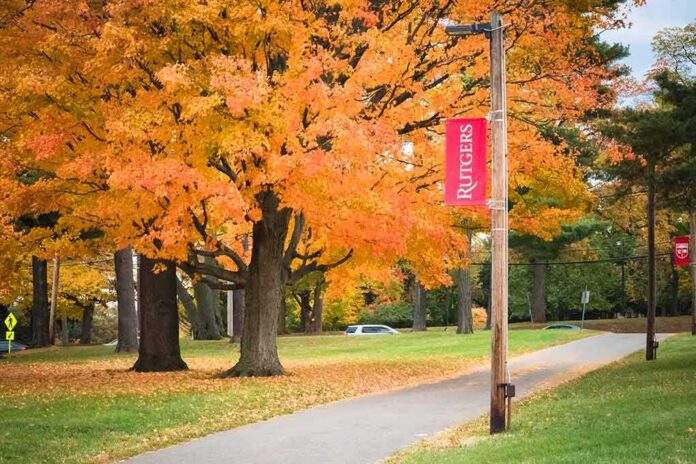
New Jersey prosecutors charged a Rutgers research dean with secretly filming an “upskirt” video on campus, a breach of trust that hits the core of safety in public spaces.
Story Snapshot
- State authorities arrested and charged Joshua Kohut with invasion of privacy.
- Prosecutors say he used a mobile phone to record an “upskirt” video without consent.
- Rutgers placed Kohut on leave and barred him from campus during its review.
- New Jersey law treats upskirting as invasion of privacy under settled case law.
Prosecutors Lay Out The Charge And The Setting
New Jersey’s top law enforcement office announced the arrest of Joshua Kohut, 51, a Rutgers School of Environmental and Biological Sciences research dean, on a fourth-degree invasion of privacy charge. Officials said the alleged recording happened on university grounds and involved a phone held to capture under a woman’s clothing without her knowledge. The Attorney General’s office said investigators seized a device and found video evidence consistent with the allegation, which anchors the criminal charge.
Rutgers responded fast once informed of the charge. The university placed Kohut on administrative leave and barred him from campus while it conducts its own process. The school’s leadership page shows his role oversees research compliance and ethics, which raises the stakes for public trust when such an official faces a privacy charge. Officials framed the conduct as an individual matter, while signaling that campus safety and dignity are non-negotiable standards.
What The Law Says About Upskirting In New Jersey
New Jersey courts have already answered the key legal question. The Appellate Division held that invasion of privacy covers images taken under clothing even when intimate parts are not fully visible, so long as the target is an intimate area shielded by garments. That ruling closed a once-exploited gap. The state statute bans secretly photographing or filming a person’s intimate parts without consent. Legislators and courts aligned the law with common sense: clothing is not a loophole; it is a boundary.
That clarity matters on campus, where phones are everywhere and moments are fleeting. The state’s view treats image-based abuse as a violation of privacy and dignity, not a prank. A 2023 review describes upskirting as part of a broader shift where society recognizes that hidden-image crimes harm victims long after the moment ends. That frame fits a conservative reading of order and respect: people should walk in public without fear that a stranger will exploit a camera to invade their bodies’ private spaces.
The Trust Gap When A Compliance Leader Is Accused
Universities sell trust: parents send teens to live, learn, and grow under adult supervision. Kohut’s job description includes research oversight and ethical standards. When a leader in that lane faces a charge tied to secret recording, the optics cut deep. Institutions protect their mission by acting fast and keeping guardrails tight. Rutgers’ swift leave-and-ban move aligns with that duty. The case also reminds leaders that codes of conduct mean little without quick enforcement when lines are crossed.
Rutgers University dean caught filming ‘upskirt’ videos: ‘extremely disturbing charges’ https://t.co/rVUCUmrIlg
— Dian (@Dian5) August 26, 2026
Prosecutors will carry the burden in court, and Kohut is presumed innocent. But the policies that shield students and staff cannot wait for a verdict. Cameras are small, storage is huge, and digital files spread fast. That reality demands bright lines, strong reporting channels, and visible consequences. New Jersey law supplies teeth. Campus leaders must supply spine. A culture that says “not here, not ever” is the surest deterrent, backed by the clear reach of the privacy statute.
Sources:
nypost.com, onnj.com, sebsnjaesnews.rutgers.edu, extension.rutgers.edu, patch.com
© targetdailynews.com 2026. All rights reserved.