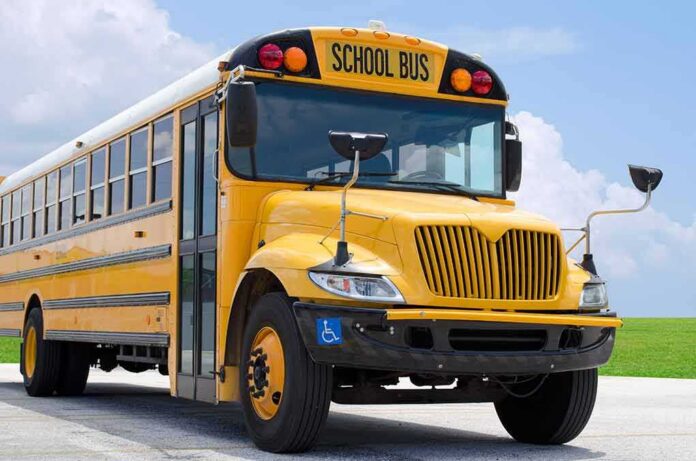
The coroner says a seven-year-old girl died on a school bus because a restraint pressed into her neck while she sat in her wheelchair, and the district’s own email blamed improper strapping by the bus crew.
Story Snapshot
- The autopsy found positional asphyxiation from restraint pressure on the child’s neck and chin.
- A superintendent’s email said the driver and monitor failed to strap her properly, “causing her death”.
- The bus company disputes that early account and says facts were still unknown then.
- Police have bus video; the autopsy notes a delay in care before 911 contact.
What the autopsy says happened inside the bus
The Hamilton County Coroner described a mechanical chain that ended fast and fatal. The child’s buttocks slipped forward on the wheelchair seat. Her torso rotated to the right. A restraint then pressed into the right side of her neck and chin. That compression cut off breathing and led to quick loss of consciousness, the report states. The manner of death is accidental. That classification defines intent, not whether procedures or training failed along the way.
The autopsy also records a “delay in care” before emergency services were contacted. That detail raises two distinct questions. First, how was the wheelchair and the child’s body secured when the ride began? Second, once her posture changed, how long did it take the adults to notice and act? Those are separate safety steps: secure the chair, secure the rider, and monitor during travel. Each step must be right, every time, with special-needs students.
The district’s early email and the bus company’s pushback
Hours after the tragedy, Cincinnati Public Schools’ Superintendent Shauna Murphy wrote to the school board. She said First Student’s chief executive told her the driver and monitor “did not strap her on appropriately, causing her death”. That is a stark sentence with a direct claim of fault. First Student disputes that account. The company says the call happened before any investigation, many facts were unknown, and that the superintendent’s description does not match the circumstances or later coroner findings.
First Student says it is working with authorities and the district to establish the facts and cannot share more while the investigation is active. The company also says it preserved the bus video and gave it to police, a step that could answer key questions about securement and monitoring once investigators release it. From a common-sense view, the tape and timing records will matter more than dueling early statements. The camera does not have a stake in the outcome.
Securement versus monitoring: two failures can coexist
Wheelchair transport has two different restraint systems. One secures the wheelchair to the floor at four points. A separate three-point belt secures the rider. Federal guidance stresses both, plus steady monitoring during travel. The autopsy’s description fits a restraint-positioning failure: the child slid, twisted, and the belt pressed on her neck, not her chest or pelvis. That suggests either incorrect setup, poor fit, or loss of proper position during motion. It does not by itself say who failed at which step.
The “delay in care” makes the monitoring question urgent. If adults did not spot distress soon enough, that compounds risk even when equipment is installed. The law often treats these as separate duties. Courts have dismissed cases even after bad outcomes when plaintiffs could not tie a specific breach to the injury under the rules that govern schools and contractors. Tragic does not always equal liable. But process failures, if proved, demand fixes and accountability.
What evidence can close the gaps now
Three items can settle most disputes about cause and responsibility. First, the full bus video with timestamps can show how the chair and belts were placed, when posture changed, and how long until staff intervened. Second, the complete autopsy file and diagrams can confirm the angle and pressure points that blocked the airway. Third, route and dispatch logs, the 911 call, and emergency medical records can map the delay in care that the coroner flagged. Together, these records turn claims into facts.
Policy should not wait for a lawsuit. Districts and contractors should retrain every driver and aide on wheelchair securement and rider belts, verify each route with a checklist, and require active monitoring with documented seat checks. Conservative values favor clear rules, personal duty, and consequences when duty lapses. Families deserve more than condolences; they deserve a system that does the basics right, every single trip, so no child’s safety hangs on a misunderstanding of a strap.
Sources:
nypost.com, wcpo.com, cincinnati.com, wlwt.com, fox19.com, local12.com, static.nhtsa.gov
© targetdailynews.com 2026. All rights reserved.