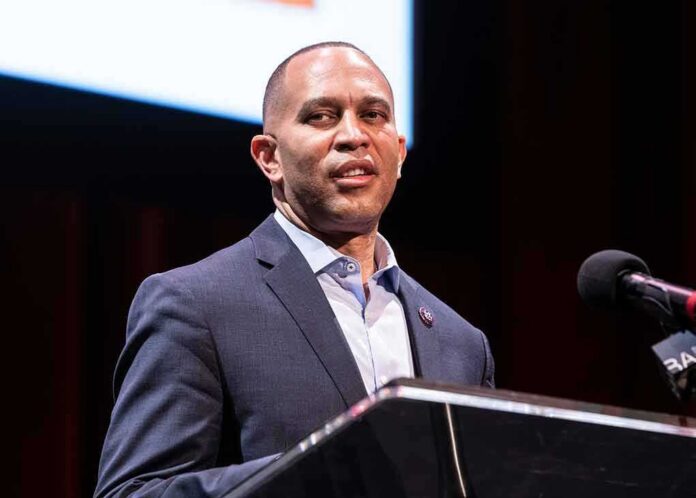
House Democratic Leader Hakeem Jeffries says he backs bringing deported DACA recipients back into the United States and giving them what he calls “remedial assistance.”
Quick Take
- Jeffries told PBS NewsHour on November 10, 2026, that he “certainly” supports returning deported DACA recipients to the country.
- He tied the support to people “treated unfairly and unjustly” by the Trump administration, not to every deported recipient automatically.
- Jeffries did not explain what “remedial assistance” means or how the government would carry out any return.
- White House officials and even a Democratic strategist pushed back, calling the idea an extreme open-border stance.
What Jeffries Told PBS NewsHour
During a PBS NewsHour interview, a reporter asked Jeffries if he supported bringing deported DACA recipients back into the country. He answered with one word: “Certainly.” The exchange appears in the full PBS transcript and matches the account posted on his own official House website.
Jeffries then went further than a simple yes. He said anyone, whether a citizen, someone here lawfully, or a DACA recipient “treated unfairly and unjustly by the administration,” deserves “remedial assistance” to “undo the damage that’s been done.” That phrase, remedial assistance, became the headline detail across conservative and mainstream coverage alike.
Jeffries did not say how many people this would apply to. He gave no list of names, no removal dates, and no description of which cases his office considers unfair. The statement reads as a broad political promise rather than a detailed plan, which left reporters and critics filling in the blanks on their own.
DACA Status Never Guaranteed Protection From Removal
Deferred Action for Childhood Arrivals, known as DACA, has never been a green card or a shield against deportation. United States Citizenship and Immigration Services guidance states plainly that recipients can still face serious consequences if they are removed, especially if they left the country without special travel permission called advance parole. That legal reality is why Jeffries’s comment raises more questions than it answers.
Whether a specific removal was improper, whether that person can legally come back, and what the government owes them if so, are three separate questions. Jeffries’s PBS answer blends all three into a single sentence. Sorting out which deportations were lawful and which were not would require case-by-case review, not a blanket policy statement made on live television.
Pushback From the White House and Even Fellow Democrats
The reaction came fast. A White House spokeswoman argued that Democrats care more about illegal aliens than American citizens, according to one report covering the remarks. That critique lands squarely on the central weakness of Jeffries’s statement: he offered sympathy and assistance without defining who qualifies or how taxpayers would fund it.
Even a Democratic strategist was quoted criticizing the position, calling it a return to an “extremist open-border” stance, with one report noting that close to 80 percent of voters oppose amnesty-style policies. Townhall went further, framing the proposal as compensation and asking whether Jeffries intends to “write them a check” with taxpayer money. That interpretation stretches beyond Jeffries’s actual words, but his vague phrasing invited it.
🚨 JEFFRIES BACKS FUNDING RETURN OF DEPORTED DACA RECIPIENTS WITH TAXPAYER COMPENSATION
House Democratic Leader Hakeem Jeffries says he supports bringing previously deported DACA recipients back to the U.S. and providing them taxpayer compensation.
The proposal raises…
— Mossadil Commentary (@MOSSADil) November 11, 2026
The Open Questions Jeffries Left Behind
Nothing in the public record shows a dollar figure, a responsible federal agency, or a timeline for delivering any assistance. Nothing identifies the legal pathway, whether that means parole, reopened removal cases, new legislation, or an executive order, that would let anyone actually return to the country. Jeffries’s office has not released a formal bill or detailed memo explaining the plan.
For a Democratic leader positioning his party to govern, that level of vagueness is a real liability. Americans have every right to ask basic questions before supporting a new government benefit: who gets it, how much it costs, and who decides. Jeffries answered none of those questions on PBS, and his party will need better answers before this idea becomes more than a talking point.
Sources:
yournews.com, jeffries.house.gov, breitbart.com, mediabias.news, meridian.news, pbs.org
© targetdailynews.com 2026. All rights reserved.