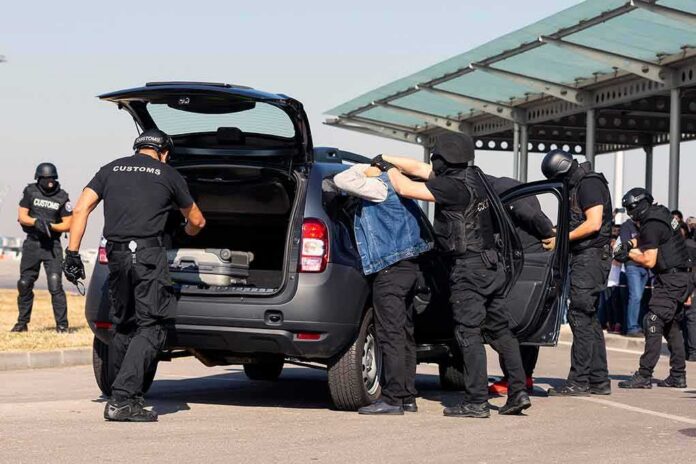
Agents say a thrice-deported suspect used his car as a weapon, crushed a federal officer’s foot, and fled before a warrant-led arrest brought him in.
Story Snapshot
- Homeland Security Investigations arrested Jesus Israel Garcia-Cobarruvias after an August 31 encounter in Martinez, California.
- Officials say he accelerated toward officers, injured one, and damaged a government vehicle before fleeing.
- Federal court filings describe the officer’s crushed foot and a driveway escape attempt.
- Assault on a federal officer carries up to 20 years in prison if convicted.
What DHS Says Happened In Martinez
The United States Department of Homeland Security reported that on August 31, 2026, in Martinez, California, Jesus Israel Garcia-Cobarruvias allegedly accelerated his vehicle toward Immigration and Customs Enforcement officers, injured one, damaged a government vehicle, and then fled. Homeland Security Investigations agents later arrested him on a federal warrant. The agency identified him as a three-time previously removed Mexican national. These core details anchor the case and come from the government’s official account.
Local reporting aligns with those basics and adds vivid detail from a federal complaint. The complaint states officers tried to pull Garcia-Cobarruvias from a vehicle in a driveway before dawn. He allegedly pressed the accelerator while an officer was alongside the vehicle. The officer’s foot was run over and crushed as the suspect dragged agents and sped off. Prosecutors charged assault on a federal officer. A judge scheduled further proceedings following the arrest.
The Charge, The Stakes, And Why It Matters
Assault on a federal officer is a serious felony, and the law does not excuse attacks because someone dislikes the arrest decision. Defense lawyers sometimes argue self-defense or excessive force. Those are rights in court, not passes to use a car against agents. Prosecutors say Garcia-Cobarruvias faces up to 20 years in prison if convicted. That penalty reflects a clear norm: you do not injure federal officers and drive away from a lawful arrest action.
Public safety rests on a plain standard many Americans share: hold the line on violent conduct during arrests, no matter the politics. Agents serve warrants and take risks so others do not have to. When someone uses a vehicle against them, that crosses a bright red line. The government’s narrative here is specific, time-stamped, and consistent with the federal complaint. The case will still move through court. Charges remain allegations until a jury or plea resolves them.
How This Fits A Broader Enforcement Pattern
Immigration enforcement encounters often start with an agency narrative and a set of charges. Counter-claims, if any, tend to surface later in motions or hearings. Experts and advocates debate use-of-force trends in these operations, with some groups alleging overreach and others noting that tactics often mirror wider policing practices. Whatever those debates, ramming or running over an officer’s foot with a car is not process or policy. It is a violent act that courts have long treated as a felony.
ICE HSI San Francisco special agents arrested Jesus Israel Garcia Cobarruvias, a VIOLENT MURDROUS CRIMINAL ILLEGAL ALIEN MEXICAN pursuant to a federal arrest warrant for assault of a law enforcement officer.
The arrest stems from an August 31, 2026, incident in which Garcia… pic.twitter.com/QtB3wOVT54
— RealAmerica (@ARealAmericano) October 4, 2026
Conservative common sense says we back the badge, enforce the law, and protect the public. That starts with consequences for those who turn cars into weapons. The Martinez incident, as charged, reinforces a simple boundary: resist if you must in court, not with force in a driveway. If the facts hold as the Department of Homeland Security and prosecutors say, a strong sentence would signal that federal officers cannot be maimed on American streets without a heavy price.
Sources:
pjmedia.com, ktvu.com, hoodline.com, cnn.com
© targetdailynews.com 2026. All rights reserved.