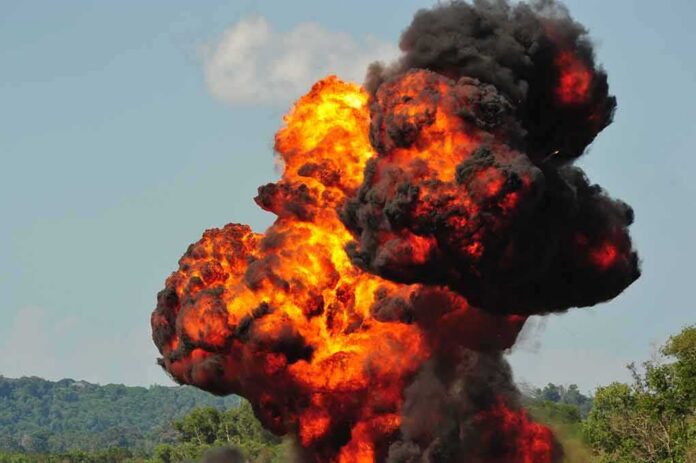
Six Russian airmen died Tuesday when one of Moscow’s oldest nuclear-capable bombers went down in flames in the Far East, just moments after leaving the runway.
Quick Take
- A Russian Tu-95 strategic bomber crashed in the Amur region on September 29 during a training flight.
- The Russian Defense Ministry says six crew members died and one was injured and taken to a hospital.
- The plane went down in an empty area near the village of Krasnoyarovo, close to Ukrainka air base.
- The Tu-95 fleet, first built in the 1950s, has a long history of crashes and fires in this same region.
What Russia’s Defense Ministry Says Happened
Russia’s Defense Ministry confirmed the crash in a short statement released the same day. The ministry said the Tu-95 went down “during a training flight” and that six crew members died while one was injured and evacuated to a medical facility. Russian outlet Kommersant carried the same casualty figures, citing the ministry directly as its source for the death toll.
The bomber crashed in an unpopulated area near Krasnoyarovo, a small village in the Amur region not far from Ukrainka air base, according to defense officials. The ministry said no weapons or ammunition were aboard the aircraft at the time. A military commission has been sent to the crash site to determine what caused the accident, following standard procedure after Russian air disasters.
A Bomber Built For The Cold War Still Flies Combat Missions
The Tu-95, known to Western militaries as the “Bear,” first entered service in the 1950s and remains one of Russia’s three strategic bomber types. It is propeller-driven, unusual for a plane its size, and carries nuclear-capable cruise missiles. Despite its age, Russia has used the Tu-95 repeatedly to launch missile strikes against Ukraine throughout the war, keeping the aging airframe in near-constant rotation.
Early reports on the cause differed slightly. One outlet reported the crash followed an engine failure during takeoff, while another cited a fuel explosion as a possible trigger. Separate reporting put seven crew members aboard the flight rather than the ministry’s account, with one person surviving. These differences reflect the usual scramble of early wartime-adjacent reporting rather than a dispute over the core facts: a Tu-95 went down, and most of its crew did not survive.
Decades Of Trouble At The Same Amur Air Base
This is not the first time a Tu-95 has crashed near Ukrainka. In June 2015, a Tu-95 caught fire and ran off the runway there during takeoff, killing two crew members and prompting Russia to ground its entire Tu-95 fleet for a review. A separate 2015 incident saw a Tu-95 lose three of its four engines mid-flight, forcing the crew to bail out over the Khabarovsk region. Those earlier accidents set a pattern that this week’s crash now joins.
BREAKING:
A Tu-95 strategic bomber crashed in Russia’s Amur region.
Six crew members were killed. One is in critical condition. The cause of the crash is still unknown. pic.twitter.com/K5gL85lIA6— Visegrád 24 (@visegrad24) September 29, 2026
Reports have also noted that a Tu-95 overran a takeoff runway at the same Ukrainka airfield in a past incident tied to an in-flight engine fire, a mechanical failure mode that keeps recurring in the fleet’s history. For a bomber fleet built before most of its current pilots were born, repeated engine and fire-related failures raise real questions about how much longer Russia can keep these planes flying combat and training missions without more losses like this one.
Sources:
en.apa.az, defence-blog.com, united24media.com, indiatoday.in, themoscowtimes.com
© targetdailynews.com 2026. All rights reserved.