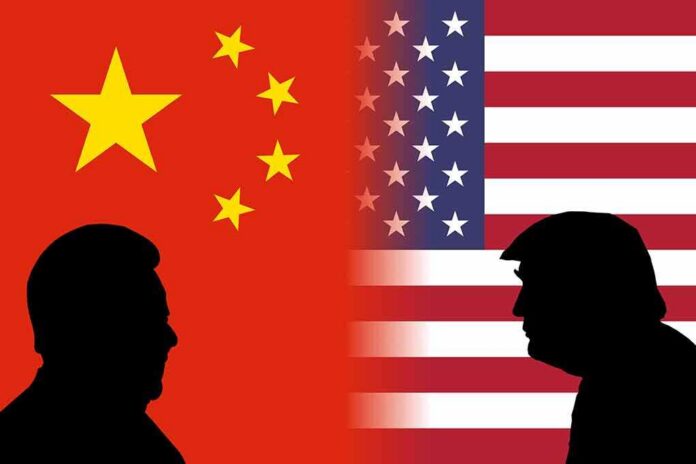
China blocked a credentialed Bloomberg reporter from the Trump–Xi–Putin meeting minutes after she shouted a sharp question at an earlier session.
Story Snapshot
- Chinese officials denied Annmarie Hordern access to the trilateral opening remarks after a shouted question in a prior meeting.
- Pool reporters said China called shouted questions “extremely rude” and warned press they would be removed for doing so.
- The White House pressed China to let Hordern back in; Chinese authorities refused, according to the pool report.
- The question referenced Nvidia’s former chief executive officer, Jensen Huang, and alleged disloyalty to the United States.
What Happened, In Order
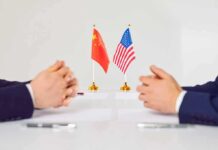
Bloomberg correspondent Annmarie Hordern asked a loud, unscripted question during a Trump–Xi photo op. She asked President Trump whether Jensen Huang had been disloyal to the United States, which drew attention in the tight room. Later that day, Chinese officials barred Hordern from entering the trilateral meeting featuring Trump, China’s Xi Jinping, and Russia’s Vladimir Putin. A White House official pushed for her reinstatement. Chinese officials stood firm and did not allow her in, according to multiple reports.
Traveling press reported that Chinese authorities sent word that yelling questions was considered extremely rude. They warned that anyone who shouted would be pulled from the room. This warning was described as applying to the pool, not just one reporter. The action linked back to Hordern’s earlier question, which came during a set-piece moment when leaders usually give short remarks and leave without taking questions. The sequence was clear, even as access rules felt opaque to the press.
Why This Matters Beyond One Room
The clash sat at the center of two real norms: order in press sprays and the principle that access should not be a punishment tool. The White House Correspondents’ Association guidance tells reporters not to shout over colleagues, yet it also admits that brief appearances can get messy and loud. American press culture often treats a shouted question as fair game when time is tight. China’s approach leans toward strict control and scripted moments.
The White House’s attempt to get Hordern back in added weight. When the United States government asks for a journalist’s access and gets a hard no, the incident stops being a minor decorum fight. It becomes a diplomatic data point. That is especially true at a summit that already ran with limited press visibility. Pool reports also noted tight controls on devices and movement on this trip, which added friction for journalists trying to do basic reporting tasks.
The Jensen Huang Angle Raises The Temperature
Hordern’s question invoked a tech figure whose name reads like a pressure gauge for the United States–China technology race. Mentioning alleged disloyalty during a moment with Xi shifted attention to national security themes. That content likely made China even less willing to allow a back-and-forth. The question did not violate a public, preposted rule that reporters could see, based on the reporting. But Chinese officials framed the issue as conduct, not content, when explaining the removal risk to the pool.
President Donald Trump opened a historic but brief 80-minute trilateral summit with Chinese President Xi Jinping and Russian President Vladimir Putin in Shenzhen on Thursday by criticizing “old school” American diplomacy. He said no problems were solved or peace forged by… pic.twitter.com/0heGrmiLg9
— TheSeekingSeagull (@TSSeagull) November 19, 2026
Some will argue that order matters and that pool sprays are not press conferences. That is true. But punishing access after the fact often chills reporting. American common sense holds two thoughts at once: do not wreck the room, and do not turn credentials into a speech code. A narrow warning or a reset usually solves this. Excluding a single reporter from a world-stage event is a bigger hammer than the moment required. The fact that the rule came through informal messages makes it feel ad hoc, not evenhanded.
How To Read This, Going Forward
Expect tighter choreography whenever China hosts high-level media moments with foreign leaders. Foreign correspondents in China have long faced hurdles, from delayed visas to constrained access. This case lands in that pattern. It also reminds American outlets to brief teams on both sets of norms: the White House’s spray etiquette and the host country’s stricter rules. The best defense for press freedom is clarity, consistency, and a united front when access becomes a bargaining chip.
Sources:
yahoo.com, thenightly.com.au, bostonglobe.com, wrbl.com, thedailybeast.com, whca.press
© targetdailynews.com 2026. All rights reserved.