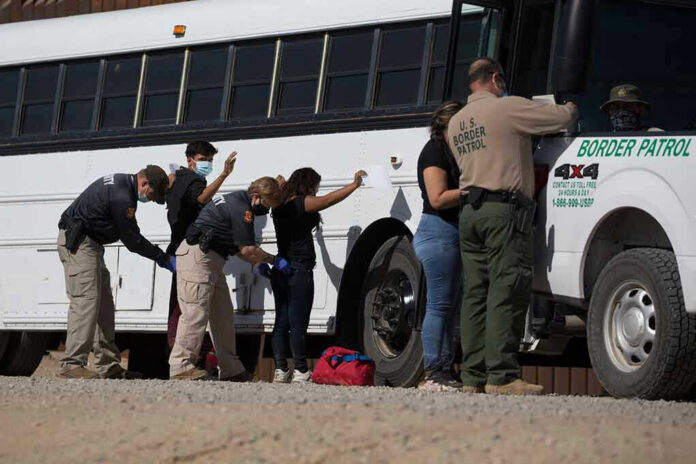
The Supreme Court blessed border turnbacks on a defunct policy—and the fallout starts now.
Story Snapshot
- The Court said a prior turnback policy was lawful, even though it ended years ago [3].
- The decision leans on a view that asylum rights start after physical entry [4].
- Lower courts had ruled against broad asylum shutdowns, creating a clash [1].
- Congress can fix the statute; until then, the ruling shapes border playbooks [4].
What the Supreme Court actually decided and why it matters
The Supreme Court ruled that a past border turnback policy fit current law, despite the policy being inactive since 2021 [3]. The justices signaled that people who have not stepped onto United States soil do not trigger asylum text in the same way as those who crossed the line [4]. That framing gives border officers more room to hold people outside the gate. The Court also said Congress can rewrite the rules if it wants clearer access at the line itself [4].
This did not happen in a vacuum. The legal fight has seesawed for years. The United States Court of Appeals for the Ninth Circuit held in 2024 that systematic turnbacks at ports broke the law and due process guarantees, and it backed a district court that said the same [4]. Advocacy groups cast the practice as a denial of the right to ask for safety. The Supreme Court’s new ruling undercuts that view by reading the statute’s trigger more narrowly [3].
The collision with other major rulings creates a messy map
The United States Court of Appeals for the District of Columbia Circuit in April 2026 rejected a sweeping presidential proclamation that tried to shut down asylum using an “invasion” claim [1]. That court said the executive cannot sidestep procedures that Congress set in the immigration law. The Supreme Court’s turnback ruling does not erase that holding; it lives alongside it, and that creates tension on the ground. Officers now face split signals about what they can do where, and how far they can push at the ports [1].
Bloomberg Law reported that the Supreme Court’s case involved a defunct policy, which blunts its direct reach day to day [3]. Still, agencies study Supreme Court language and then mirror it in new memos. That is the real effect. A narrow reading of “arrives” can become standard at ports. The Center for Gender and Refugee Studies tracks litigation that argues turnbacks still violate the law and the rule against sending people back to danger; that push will continue [4].
The key word driving everything: “arrives”
The legal fight turns on one plain word: arrives. The Court’s current majority treats “arrives” to mean physical entry onto United States soil before asylum rights attach in full [4]. That reading meshes with a border control view that the line is a legal wall. Opponents argue that ports of entry are the front door, and the statute protects people who present there in good faith. Until Congress speaks, the Court’s reading sets the upper hand for officers at the gate [3].
Conservative readers should ask a simple question: Who writes the rules—the people’s branch or judges? The Court’s message says Congress holds the pen. If voters want a different rule for people at the line, lawmakers must amend the asylum statute. That keeps with separation of powers and basic common sense. Border officers need clear rules they can follow in real time, not shifting orders from one injunction to the next [4].
What changes next at the border and in Washington
Expect the Department of Homeland Security to refine port-of-entry scripts. Officers will likely require clear, physical entry before routing people into asylum processing. That line may tighten wait areas and reinforce metering-like practices, with closer control at bridges and gates. At the same time, the District of Columbia Circuit’s bar on sweeping asylum shutdowns limits any broad effort to close the system beyond the ports. The two tracks will grind against each other in new lawsuits [1].
The Supreme Court Says the U.S. Can Turn Away Asylum Seekers at the Border #SupremeCourt #AsylumSeekers #ImmigrationLaw https://t.co/pq3SksofMb pic.twitter.com/bMYv5M01Vc
— Meyner and Landis (@ML_LawFirmNJ) June 25, 2026
Congress has two real options. Lawmakers can codify turnbacks by defining “arrives” as physical entry only. Or they can expand access by stating that arrival at a port, even outside the turnstiles, triggers asylum rights. Either move would stop the whiplash. Until then, expect more piecemeal orders, more videos from bridges, and more confusion. The Court opened a door for tighter port control; whether leaders walk through it, and how far, is now a test of will and accountability [3].
Sources:
[1] Web – BREAKING: Supreme Court Sides with Trump, Allows Immigration Officials …
[3] Web – Border Restrictions and Court Orders 2017-2026
[4] Web – Supreme Court Rules Defunct Border Turnback Policy Is Lawful
© targetdailynews.com 2026. All rights reserved.