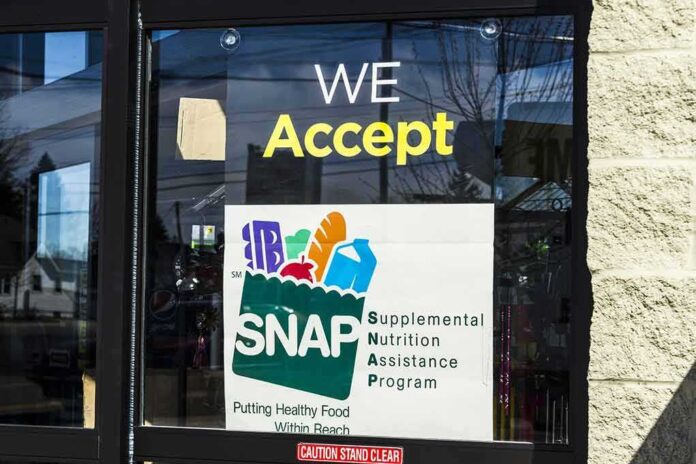
One threat from Washington has turned America’s quiet food lifeline into a front‑line battle over fraud, privacy, and whether blue states will bend when the federal government says, “No data, no money.”
Story Snapshot
- USDA, under President Donald Trump, is tying key SNAP funds to states’ willingness to share detailed personal data on recipients.
- More than 20 Democratic-led states and D.C. are suing, calling the demand unlawful, dangerous for privacy, and a backdoor immigration tool.
- A federal judge has temporarily blocked USDA from cutting funds, but the administration is still signaling it intends to push the limit.
- The outcome could redefine how much personal data the federal government can demand in exchange for basic safety‑net benefits.
How a food program became a political weapon
SNAP was designed as a simple promise: if a household’s income drops below a set line, the federal government helps put groceries in the cart while states handle the paperwork. That balance shifted when President Trump signed an executive order in February 2025 pushing agencies to pry deeper into benefit data, and USDA responded by ordering states to ship over detailed, person‑by‑person files on every SNAP recipient, from Social Security numbers to addresses and immigration categories.
Most Republican-led states, already aligned with the administration’s anti-fraud rhetoric, eventually agreed to the data dump. Democratic-led states and the District of Columbia did not. Their governors and attorneys general argued that nothing in SNAP law authorized such sweeping collection, and that once the data left their systems, it could easily feed broader immigration crackdowns or criminal databases, chilling participation by families who are fully eligible but wary of federal surveillance.
The “no data, no money” ultimatum and the courts
The standoff escalated when Agriculture Secretary Brooke Rollins publicly declared that states refusing to comply would see key SNAP funds shut off, bluntly summarizing the policy as “NO DATA, NO MONEY.” USDA letters warned of billions in potential savings from catching deceased recipients and people allegedly double‑dipping across states, a message tailored to taxpayers who are tired of hearing about “waste, fraud, and abuse,” even though long-standing audits already show fraud rates in SNAP are relatively low compared with the program’s scale.
Democratic states answered by filing multistate lawsuits that turned a policy memo into a constitutional showdown. They argued that Washington cannot hold a basic entitlement hostage to extract open‑ended data and that threatening to yank food assistance from tens of millions of low‑income residents in blue states looks less like stewardship and more like partisan punishment. A federal judge agreed, at least for now, issuing a preliminary injunction that bars USDA from cutting SNAP funding to the suing states solely because they refused the data demand.
Fraud, privacy, and conservative common sense
Anti-fraud goals resonate strongly with conservative instincts about accountability, and there is nothing unreasonable about expecting states to help catch people who game the system. The question here is not whether fraud should be fought, but whether a nationwide, person‑level data sweep—targeted most aggressively at political opponents—actually reflects limited government or veers into the kind of centralized surveillance conservatives have historically resisted, especially when the administration has also tied social program data to immigration enforcement priorities.
Supporters of the USDA line say, with some justification, that states that have “nothing to hide” should welcome a federal cross‑check to keep benefits focused on those who truly qualify. Opponents counter that the directive asks for far more than what is needed to validate eligibility, that similar error patterns exist in red states that already complied, and that threatening to destabilize food aid for working families, seniors, and veterans in order to win a data fight looks less like responsible stewardship and more like using hunger as a bargaining chip.
For millions of households, these arguments are not abstract. State agencies now must plan budgets and staffing under the cloud of losing federal administrative dollars, which pay for call centers, eligibility workers, and the systems that make EBT cards actually work. Even if benefits remain legally owed, confusion and backlogs can freeze aid in practice, especially for people already living one missed paycheck away from an empty fridge. Immigrant and mixed‑status families may simply walk away from the program rather than risk putting their personal information into a contested federal database.
What this showdown means for the future
The legal outcome will either harden or redraw the lines on what the federal government can demand when it holds the purse strings. If USDA ultimately prevails in court or Congress chooses to bless broader data-sharing authority, future administrations—of either party—will inherit a powerful precedent: turn core safety‑net programs into nationwide data mines, link them with law enforcement, and pressure reluctant states by threatening essential funds whenever they resist.
If the states win, the decision will likely anchor firmer protections around privacy and state autonomy, limiting agencies’ ability to staple sweeping data grabs onto programs that were never meant to double as surveillance tools. Either way, this clash has already exposed a hard truth: the modern welfare state runs on data as much as dollars, and the fight over who controls that data—federal enforcers or state stewards answerable to their own voters—will shape not just how fraud is policed, but how far Americans are willing to go in trading privacy for the promise that government help is reaching only the “right” people.
Sources:
GV Wire – Trump to halt some food aid support for Democratic-led states over data fight
Daily Fly – “No data, no money”: USDA says states who don’t hand over info will lose SNAP funding
Mother Jones – USDA to blue states: hand over personal data or lose SNAP funding
Grocery Dive – USDA’s Brooke Rollins threatens to withhold SNAP funding from Democratic states
The Intelligencer – USDA demands states undo full SNAP payments
USDA – 2025 Food and Nutrition Service Explanatory Notes