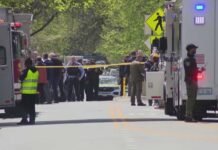
Five middle school students saved 40 lives when their bus driver collapsed at the wheel on a Mississippi highway, coordinating a precision rescue that would challenge most adults in a crisis.
Story Snapshot
- Driver Leah Taylor, 46, blacked out from an asthma attack while driving 40 students on a four-lane highway in Hancock County
- Five students ages 12-15 simultaneously took control of steering, brakes, 911 calls, and medical aid within seconds
- Jackson Casnave, 12, grabbed the wheel while Darrius Clark hit the brakes and sister Kayleigh called emergency services
- All passengers emerged uninjured as the bus stopped safely on the highway median
- The driver made a full recovery and credited the students with saving everyone’s lives
When Chaos Demands Instant Leadership
The bus lurched sideways on the highway. Twelve-year-old Jackson Casnave sat directly behind driver Leah Taylor and watched her reach for medication before slumping unconscious. No time for panic. No time for permission. The sixth grader lunged forward and seized the steering wheel as the vehicle carrying 40 students veered toward disaster. What happened next demonstrates something schools rarely teach but desperately need: the capacity of young people to function under impossible pressure when adults cannot.
Taylor had suffered an asthma attack severe enough to render her completely unconscious on a busy four-lane highway. The scenario represents every parent’s nightmare and every school administrator’s liability concern. Yet within seconds, five students transformed from passengers into a coordinated emergency response team. Darrius Clark, also 12, applied the brakes. His sister Kayleigh, 13, fought through screaming chaos to reach 911 dispatchers. Fifteen-year-old Destiny Cornelius located Taylor’s nebulizer and administered the medication. McKenzy Finch, 13, cradled the driver’s head and answered her ringing phone to alert the transportation department.
Character Reveals Itself When Systems Fail
The students received zero training for this scenario. No emergency drills prepared them. No adult supervised their response. They simply acted because someone had to, distributing responsibilities with an efficiency that suggests instinct might be a better teacher than curriculum. Jackson Casnave later reflected with remarkable composure: “I didn’t have time to process my emotions. I just wanted to make sure that nobody got hurt.” That statement encapsulates a maturity that transcends age, the ability to subordinate fear to purpose when lives hang in the balance.
Principal Dr. Melissa Saucier praised what she witnessed: “What they did took courage. They didn’t wait for somebody to step in, they stepped up themselves, and that says a lot about their character.” The observation matters because it highlights a quality increasingly rare in young people conditioned to wait for authority figures to solve problems. These students demonstrated agency, the willingness to assume responsibility without permission. That instinct cannot be downloaded from a smartphone or absorbed from social media. It develops from something deeper, likely nurtured by families and communities that still value self-reliance.
The Questions Nobody Wants to Ask
Taylor’s full recovery allows everyone to celebrate the happy ending, but the incident raises uncomfortable questions about school transportation safety. How many other drivers operate buses while managing serious health conditions? What protocols exist to monitor driver wellness beyond basic licensing requirements? The students succeeded despite the system, not because of it. Their heroism should inspire gratitude, but it should also provoke scrutiny of the circumstances that required children to become emergency responders in the first place.
The school responded appropriately with recognition, hosting a pep rally and planning a celebratory lunch. Taylor herself expressed profound gratitude: “I’m grateful for my students. They’re the ones that saved my life and everybody else’s on that bus.” The acknowledgment validates what the students accomplished while also revealing the precarious nature of what transpired. Adult systems failed. Children compensated. The outcome could easily have ended differently, with tragedy instead of triumph dominating headlines.
What Hancock County Teaches America
This incident occurred in Hancock County, Mississippi, a place coastal elites might dismiss as flyover territory lacking sophistication. Yet these middle schoolers demonstrated capabilities that would challenge many adults in major metropolitan areas. They coordinated multiple critical tasks simultaneously under extreme stress. They made split-second decisions with life-or-death consequences. They succeeded completely. Perhaps the education system should spend less time on abstract theories and more time cultivating the practical judgment these students exhibited naturally.
Mississippi middle school students stop bus after driver passes out https://t.co/xZjAxdVXFl pic.twitter.com/uJUgQVR68M
— New York Post (@nypost) April 25, 2026
The broader implications extend beyond one school district. Youth today face constant criticism for fragility, dependence on technology, and inability to handle adversity. The Hancock Middle School students shattered those stereotypes decisively. They proved that young people can rise to extraordinary challenges when circumstances demand it. The question becomes whether adults will create environments that nurture such capabilities or continue coddling children into learned helplessness. Based on what happened on that Mississippi highway, students possess far more capacity than most institutions credit them for having.
Sources:
Mississippi middle school students stop bus from crashing after driver blacks out – ABC News
Mississippi students prevent bus crash after driver loses consciousness – Times Now News