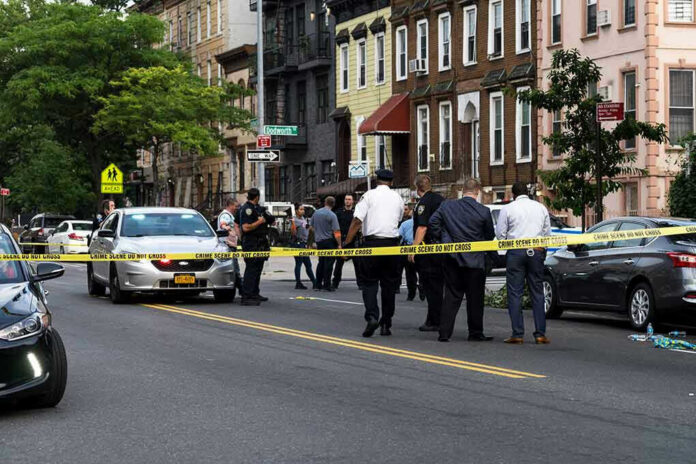
Five people, including two children, went out to watch fireworks in Brooklyn and ended up in a hospital bed, while eight adults landed in a police precinct with more questions than answers.
Story Snapshot
- Five people, including children, were shot while watching fireworks in Brownsville, Brooklyn
- Police detained eight individuals for questioning but made no arrests that morning
- New York Police Department warned about illegal fireworks and deadly risks before the holiday
- Media reports highlight chaos and child victims but leave shooter intent and gang ties unclear
Fireworks, Families, And Gunfire In Brownsville
Brownsville families gathered to watch fireworks when gunfire tore through what was supposed to be a simple holiday night, leaving five people wounded, including two children. The scene fits a pattern many New Yorkers now recognize too easily: holiday celebrations that turn into crime scenes, sirens drowning out the last crackle of fireworks. Reports describe bullets cutting through a crowd, but they stop short of confirming who pulled the trigger or why. That silence matters, because it lets other people fill in the blanks.
News 12 Brooklyn reported that police took eight individuals into custody for questioning after the Brownsville shooting, but no one had been formally arrested by late Saturday morning. Police use this step often when they have leads but not enough evidence for charges. To a common-sense reader, it signals uncertainty. Something serious happened, people were hurt, the department moved fast, yet detectives still could not say, “These are the shooters,” in a way that would hold up in court. That gap fuels both frustration and doubt.
Holiday Violence Across New York City
The Brownsville shooting did not happen in isolation. ABC7NY reported that two people were killed and nine wounded in overnight shootings across New York City during the July 4 stretch, with three child victims among those shot. When you stack that on top of Brownsville, the picture sharpens: families try to celebrate, children get caught in the crossfire, and the city spends another holiday weekend counting victims instead of safe returns. That reality collides with official claims of record-low shootings in recent years.
The New York City Police Department has publicly celebrated historic low shooting numbers, especially around July 4 weekends, pointing to data that show fewer incidents and victims compared with past years. Those statistics may be accurate at the citywide level, but they do not erase what happens when gunfire erupts in front of children on a single block. From a conservative, common-sense angle, both can be true: long-term progress and short-term failure. Telling only the success story while families in Brownsville clean blood off sidewalks rings hollow.
Police Messaging, Fireworks, And Gang Narratives
Before and around the holiday, New York Police Department social media warned residents that illegal fireworks cause fires, serious injuries, and even death. That message is correct as far as it goes; fireworks do send people to emergency rooms every year. But when five people are shot at a fireworks gathering, the main danger did not come from sparklers or roman candles. It came from a gun. Some readers will see the focus on fireworks as a way to talk about safety without fully facing the deeper problem of violent people who carry and use firearms in crowded neighborhoods.
Side A, the original framing of this Brownsville incident, leans toward a gang-related motive and claims like “two shooters firing six rounds” and children as unintended targets. The problem is that none of those specifics have clear backing in the public record. News 12 Brooklyn mentions eight people taken into custody and no arrests. ABC7NY mentions child victims as part of citywide shootings. Neither confirms the number of shooters, the exact round count, or any gang affiliation. From a conservative perspective, you do not label a case “gang-related” without evidence you can show.
The Missing Pieces And Why They Matter
What is missing is as important as what we know. There is no publicly available ballistics report that confirms how many weapons were fired or how many rounds left those guns. There is no visible witness deposition that tells whether shooters aimed at specific rivals or simply sprayed into a crowd. There is no released surveillance footage from businesses near the fireworks gathering that captures the crucial seconds when shots rang out. Without those pieces, claims about motive and intent float more like rumor than fact.
Counter-arguments are weak so far, but they do point to a real problem. Media outlets largely echo police statements and basic numbers without independent verification. They report who was detained and how many people were hurt. They rarely push for raw documents or deep forensic details that could confirm or challenge early police narratives. For a reader who values truth over spin, this should be a red flag. Respect for law enforcement goes hand in hand with demanding solid, transparent evidence, especially when children are shot in public.
Brownsville As A Test Of Trust
This Brownsville fireworks shooting sits inside a larger national story. Every summer, especially over July 4, cities across America see spikes in gun violence around big gatherings. Everytown for Gun Safety, using Gun Violence Archive data, has documented hundreds of shootings and at least 180 deaths over some holiday weekends, with injuries topping 500 across the country. That scale explains why departments rush to frame events quickly: they need to reassure the public, protect their reputation, and justify resources. Yet quick labels can outrun the facts.
For older New Yorkers, trust is built or broken in events like this. Five people shot, including two kids, at a neighborhood celebration. Eight adults pulled in for questioning but not charged. A department promoting record-low shootings, even as fresh victims lie in hospital beds. Fireworks warnings overshadow the reality of guns in the crowd. Until ballistics, witness statements, and video are brought into the light, the Brownsville case will stand as another test of whether institutions choose full truth or convenient narrative when children get hit by bullets meant for someone else.
Sources:
nyc.gov, brooklyn.news12.com, facebook.com, youtube.com, connecticut.news12.com
© targetdailynews.com 2026. All rights reserved.