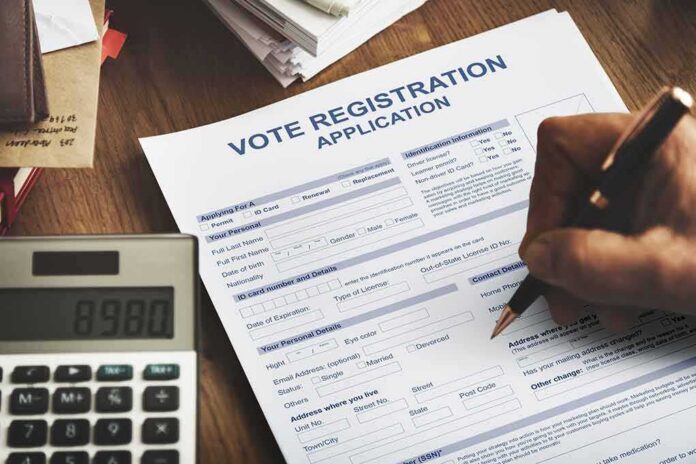
California lets people register to vote without a driver’s license or Social Security number, then confirms them later with a state-issued identifier.
Story Snapshot
- California assigns a unique voter number if you have no driver’s license or Social Security number.
- Most voters are not asked to show ID at the polls under current state rules.
- First-time voters who registered by mail without key numbers may need to show documents like a utility bill.
- Officials say database checks verify identity; critics say front-end proof is too light.
What California Actually Allows At Registration
California’s voter registration form asks for a driver’s license, a state ID number, or the last four digits of a Social Security number. The state says you can still register if you have none of these. The county will assign you a voter number for records and verification. State regulations back this up and spell out how the system handles people without those numbers by creating a unique identifier for registration purposes. That workflow sits at the heart of the argument.
Supporters of tight rules see a gap here. They argue identity should be proven up front with a government ID, not cured later in a database. California answers that it verifies data by checking records. The system matches driver information with the Department of Motor Vehicles and Social Security digits with the Social Security Administration when available. Critics counter that matches do not exist for people with neither number, so the process leans on signatures and clerical controls instead of firm documentary proof.
What Poll Workers Can And Cannot Demand
California does not ask most voters to show identification at the polling place. The state’s summary is blunt: in most cases, no ID is required before you vote in person. One key exception applies. If you registered by mail, you are voting for the first time, and you did not list the driver, state ID, or Social Security digits, a poll worker may ask for documents. Accepted items include a recent utility bill, the sample ballot booklet, another government document, a passport, a driver’s license, a state ID, or a student ID.
That list fuels the dispute over standards. A utility bill is not a photo ID, but it does tie a name to an address. California points to the federal Help America Vote Act, which allows either a valid photo ID or approved non-photo documents for certain first-time voters. Critics say that is too loose and invites error. From a common-sense lens, a rule that swings from no check for most voters to a light document check for a subset does not inspire confidence in tight control.
How The Back-End Verification Works
California’s process leans on databases. The statewide system tracks whether a person’s driver data was matched to Department of Motor Vehicles records or whether Social Security digits were verified. If neither exists, the record shows the unique identifier assigned to the voter. The Secretary of State also describes routine updates for deaths and felon status. Supporters argue these checks reduce risk and make in-person fraud rare, which the office and allied analysts have claimed in hearings and summaries.
Every democrat in California was illegally voted in. That’s why they will not pass voter id they would not stand a chance. Any state city or town that won’t pass and enforce the save act is a cheat state
— Kaye (@kaye8244) September 2, 2026
Those claims rest on low published case counts. One cited summary noted a dozen fraud cases over five years in a state with tens of millions of eligible voters. Skeptics reply that limited detection is not the same as a clean bill of health. They also point out that the state’s own materials show most voters face no ID request at the polls, and some registrants can leave key fields blank and still proceed. The integrity question then becomes where to place the burden: front end or back end.
What This Means For The Voter ID Fight Ahead
The policy stakes are simple to grasp. California’s current model maximizes ease at the front door and relies on signatures, mailings, and database checks to verify identity and eligibility. That design treats rare in-person fraud and clerical error as manageable risks within a large system. Conservatives see a mismatch between public trust and rules that rarely require an in-person ID check and allow registration without common identifiers. They favor a rule that sets the same clear standard for everyone at the point of voting.
Both sides cite law. California follows the federal menu that allows non-photo documents for certain first-time voters, and it codifies a unique identifier when core numbers do not exist. Reformers argue that the law is a floor, not a ceiling. Requiring a government ID at the polls and a government-issued number on mail ballots would align the process with common standards used to board a plane, cash a check, or enter a federal building. That alignment would likely boost perceived legitimacy at a time when trust is a scarce currency.
Bottom Line
California’s own pages confirm the core facts: you can register without a driver’s license or Social Security number and get a state-assigned voter identifier, and most voters will never show ID at a polling place. The state leans on database checks and limited first-time voter document rules to close the gap. If you think trust follows clarity, the remedy is obvious: set one bright line everyone understands and everyone meets at the same moment they vote.
Sources:
thegatewaypundit.com, sos.ca.gov, elections.cdn.sos.ca.gov, voteriders.org, ballotpedia.org
© targetdailynews.com 2026. All rights reserved.