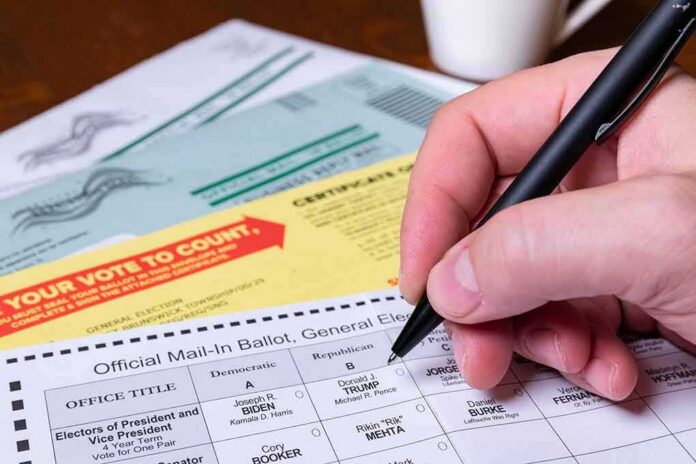
Michigan’s own rules say voters can pick a party and still cross over on candidates, and that single fact just upended an Election Day scare.
Story Snapshot
- National Republican Senatorial Committee (NRSC) sent cease-and-desist letters to four Michigan county clerks over reported bad poll-worker guidance.
- State ballot instructions and tabulator procedures allow straight-ticket plus individual candidate choices; the candidate mark controls that race.
- Michigan’s Secretary of State guidance permits split tickets in general elections but not in certain primaries.
- State officials said they received similar reports and contacted jurisdictions to fix the issue.
NRSC Intervention Targets Reported Misinformation At Polls
The National Republican Senatorial Committee sent cease-and-desist letters on November 3 to clerks in Shiawassee, Wayne, Kent, and Monroe counties. The letters said election inspectors told voters that marking a straight-party option and then choosing a candidate from another party would spoil or reject the ballot. The Shiawassee letter named a concrete scenario: a Democratic straight-party oval plus a vote for Republican Senate candidate Mike Rogers, and said the instruction was wrong. The NRSC demanded written corrections that match state rules.
Michigan’s mandated ballot instructions settle the core rule in plain text. The state’s “Ballot Instructional Language” tells voters they may vote a straight ticket and also vote for individual candidates of their choice. That is not a loophole; it is the design. The Michigan tabulator test manual defines a split ticket as a straight-party vote plus direct votes for other-party candidates and says the direct vote supersedes the party line for that office.
State Guidance: Split Tickets Are Legal In November
The Secretary of State’s public guidance draws a bright line between primaries and the November general election. Voters may not split in certain primaries, including the presidential and statewide primaries. They may split their ticket in the general election. Proposal 18-3 restored a straight-ticket option, but it did not trap voters in one column. A direct candidate mark controls that race while the straight-party choice fills in the rest. This is exactly how ballots are meant to count.
The NRSC’s requested fix mirrors that structure. The letters asked clerks to tell workers and voters that a ballot with a straight-party mark and a cross-party candidate pick is valid and must be tabulated, and that the individual candidate choice governs that contest. That is common-sense election administration: count what the voter clearly marked. That expectation aligns with conservative values about rules, clarity, and honoring voter intent without games.
Secretary Of State Office Acknowledges Reports, Moves To Correct
The Michigan Secretary of State’s office said it also heard reports about the disputed instruction. A spokesperson said state law allows voters to split their ticket in the general election and that the Bureau of Elections contacted the jurisdictions. That response matters on Election Day, when minutes count. Fast outreach lowers the odds that a worker repeats a bad script and helps voters mark their ballots with confidence that the system will read them right.
No way in hell election inspectors don't know the Split Ticket rules.
NRSC Sends Cease-and-Desist to County Clerks Misinforming Michigan Voters https://t.co/i8ytQoWSnx
— Wazzup Doc (@WazzupDoc7) November 4, 2026
The mechanics behind the rule protect voter intent at the machine level. The tabulator procedure confirms each candidate under the chosen party gets a vote except where a direct vote overrides it. That means a voter can mark a straight-party line for most races and still choose a different person in a single contest. The direct mark wins for that race. The rest follow the party line. This is not a gray area or a software guess; it is a tested procedure.
Why This Matters Beyond One County
Misstating the split-ticket rule risks two harms at once. First, it can chill voters from marking their true preference in a key race. Second, it can trigger avoidable challenges at the scanner if a voter tries to “fix” a ballot that was valid to begin with. Michigan’s public-facing instructions and test manuals already solve this, in writing. The job now is delivery: every inspector, every precinct, same script. That is the bedrock of fair, boring, trusted elections.
The dispute also shows the trap of mixing primary habits with general-election rules. Many voters remember that primaries ban mixing parties. Some workers do too. But November is different by design in Michigan. The straight-ticket option offers speed. The candidate override offers precision. Together, they protect freedom of choice. When officials reinforce that plain rule, they reduce conflict, speed lines, and keep counting clean. That is how confidence grows, race by race.
What To Watch Next
Clerks can calm this fast with a written notice to every precinct and absent-voter counting board. Chairs can re-brief workers at the top of each shift. Posting the state’s exact ballot language at check-in and at the tabulator would help voters self-verify. If counties document any misstatements and when they corrected them, they can show the public that ballots were counted as marked. That is the right standard: transparency, rule-following, and respect for voter choice.
Sources:
townhall.com, michigan.gov, abcnews4.com, edition.cnn.com
© targetdailynews.com 2026. All rights reserved.