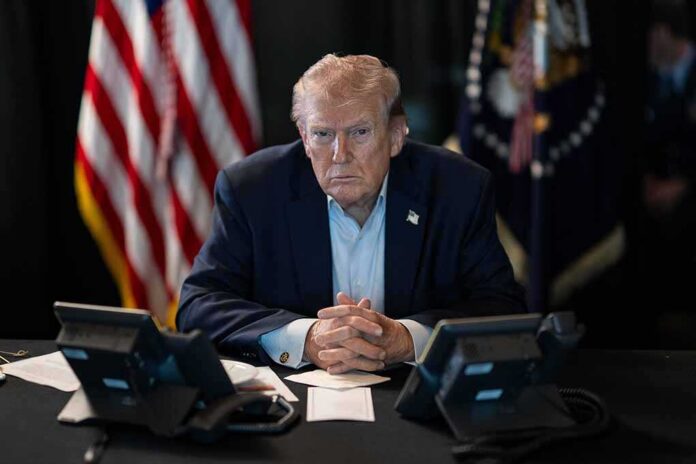
President Trump will host China’s Xi Jinping in Washington for a high-stakes state visit centered on trade, Taiwan, Iran, and artificial intelligence.
Story Snapshot
- Trump plans to greet Xi at Joint Base Andrews before a White House state visit.
- The schedule includes a formal arrival ceremony and a state dinner at the White House.
- Talks aim to steady ties and cover trade, Taiwan, Iran, and artificial intelligence.
- The visit is slated for the week of September 24 in Washington, D.C..
Who, when, and why this meeting matters right now
President Trump will welcome Chinese President Xi Jinping to Washington next week for their second meeting this year, with a public focus on trade and fast-moving tech risks. Multiple outlets report a two-day program anchored at the White House. Senior officials say Trump plans to greet Xi at Joint Base Andrews, a rare protocol signal reserved for top-tier visits. The White House schedule includes an arrival ceremony and a state dinner, adding weight to the talks.
Reporting places the visit around September 24, tying it to a window when markets and allies watch for signals on tariffs, supply chains, and security flashpoints. The agenda spans four knots that drive global risk: trade rules and tariffs, tensions over Taiwan, Iran-related security ties and energy flows, and artificial intelligence. Each front links to household prices, retirement accounts, and national security—stakes that explain the pomp and the tight choreography.
The agenda: trade levers, red lines, and tech risk
Trade sits first because it touches everything else. Reuters says both sides will seek stability and explore narrow moves, including talk of targeted tariff relief on select goods. That is not a reset of the entire tariff map, but it could ease pressure on a few sectors. The South China Morning Post and others outline a White House-led program, but the substance sits in working rooms, not the dinner toasts. A cautious, step-by-step path fits recent summit patterns.
Taiwan will test how far each side pushes in public versus private. Both leaders know that loose words invite miscalculation, so expect firm restatements more than new formulas. Iran adds energy security and sanctions exposure to the mix. Any alignment on Iran can shape oil prices and maritime risk, even if the two leaders frame it as de-escalation. These issues tie back to export controls and access to key minerals, which shadow every trade line item.
Artificial intelligence: headline heat, narrow lanes
Officials have discussed a possible sideline meeting with United States and Chinese technology leaders on artificial intelligence, but plans remain tentative, according to press reporting. Expect language about safety, misuse, and crisis lines, rather than deep code-sharing or chip-rule changes. That approach matches expert previews that predict de-escalation tools and dialogue tracks over big breakthroughs. It keeps space for guardrails without trading away leverage in semiconductors and data flows.
Trump and Xi sitting down in Washington with trade, AI, Iran, and Taiwan on the table is a pretty big deal.
This isn’t just another trade meeting. The U.S. and China are competing over technology and critical minerals while trying to prevent their economic relationship from…
— Ch1ck3nH00k (@Funker_Dev) September 20, 2026
This framing also aligns with the way think tanks describe recent United States–China summits: useful for lowering the temperature and setting up more talks, but not for solving the core fights over technology and security overnight. Voters and investors should watch for small, concrete steps—like narrow tariff trims or new hotlines—that reduce risk in the near term. Grand bargains make noise; small fixes move markets more quietly and can last longer.
Protocol signals and what they tell us
The plan for Trump to greet Xi at the air base telegraphs respect and intent to stabilize ties. A full state dinner signals that both sides want to project control at home while keeping lines open abroad. That symbolism matters because it buys time. It also narrows the political space for sudden tariff spikes or export surprises while talks continue. For Americans, that can translate into steadier prices and fewer supply shocks, even without a marquee deal.
How to judge outcomes without the hype
Measure the visit by three tests. First, did they announce a narrow trade step that touches real goods and real jobs, even if small? Second, did they set a path for an artificial intelligence dialogue that includes safety, misuse, and crisis communications without weakening export security? Third, did they reaffirm red lines on Taiwan and Iran in ways that lower the risk of sudden moves? Clear answers on those fronts will tell the story better than any photo.
Sources:
facebook.com, reuters.com, chosun.com, businesstimes.com.sg, livemint.com, bbc.com
© targetdailynews.com 2026. All rights reserved.