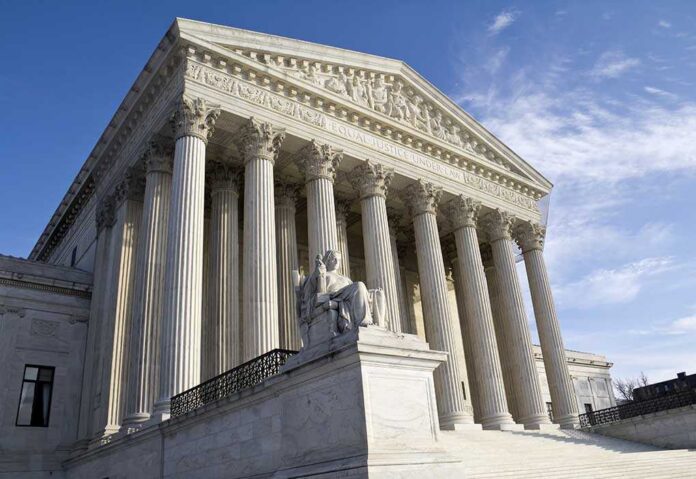
When a sitting senator says “everything should be on the table” for the Supreme Court, you are looking at the next big fight in American politics.
Story Snapshot
- Senator Raphael Warnock openly backs Supreme Court term limits and adding seats as “on the table” reforms.
- He ties these reforms to recent voting rights decisions that he says “poured fuel” on a redistricting arms race.
- Supporters call this democracy protection; critics see raw court-packing that threatens judicial independence.
- The Constitution’s promise of life tenure collides with modern anger at an unelected, highly political court.
Warnock moves Supreme Court fights from whisper to out loud
Senator Raphael Warnock of Georgia is not hinting about Supreme Court reform; he is saying it plainly on national television. In a wide-ranging interview on voting rights and the court, he backed an enforceable ethics code, term limits for justices, and even expanding the number of seats, saying those “have to be on the table” in light of what he calls a crisis for American democracy.[5] That phrase is not an offhand remark; it is now a key part of his political brand.
Warnock links his push to a specific trigger: the Supreme Court’s recent decision cutting back a major part of the Voting Rights Act by limiting how Section 2 can be used in redistricting cases.[5] He argues that this ruling, on top of earlier blows to voting protections, has “poured fuel” on a redistricting arms race that lets politicians choose their voters, not the other way around.[5] From his perspective, once the court keeps rewriting the rules of elections, the court itself becomes fair game for reform.
How he sells reform as defense of democracy, not a power grab
Warnock does not talk about expansion and term limits as a stand-alone stunt; he wraps them in a larger democracy package. In speeches and interviews he pairs court reform with the John Lewis Voting Rights Advancement Act, bans on racial and partisan gerrymandering, and ideas like statehood for the District of Columbia.[5][1] He presents this as one fight: expand voting access, cut dark money, and stop what he calls a captured court from locking in minority rule. He wants voters to see structural change as moral duty, not partisan revenge.
He also leans hard on civil rights history to make his case land. As a pastor in the pulpit once held by Martin Luther King Jr., he frames today’s fight over maps and ballots as the latest chapter in a long struggle for equal representation.[5][5] He invokes names like King and John Lewis to suggest that accepting the current court as untouchable would betray that legacy. That moral framing resonates with many of his supporters, but it also raises the stakes: when you say “democracy is on fire,” half measures no longer sound serious.
Everything on the table… except the details
For all the bold talk, there is a striking gap in specifics. Warnock has not released a detailed plan that answers basic questions: How many seats should be added? How long should a justice serve under term limits? Would those limits apply to current justices or only to new ones? The public record so far shows rhetoric and priorities, not bill text with real mechanics.[5][1] That lack of detail gives allies flexibility, but it also makes critics’ job easier.
That vagueness also feeds a deeper worry on the right and among some institutionalists. If the number of justices becomes just another partisan lever, nothing stops the next majority from doing the same thing. Life tenure for federal judges is written into Article III of the Constitution as service during “good Behaviour.” Side B of this debate points to that clause as a serious obstacle to statutory term limits, which could require a constitutional amendment or creative workarounds through senior status. Without a clear model, Warnock’s “all options” slogan can sound more like a threat than a plan.
Why his push alarms conservatives who still care about guardrails
For many conservatives, the core issue is not whether they like a given ruling; it is whether politicians should punish the court for those rulings. The court’s job is to say what the law is, even when elected officials hate the answer. From that view, Warnock’s timing looks suspect: he ramps up reform talk right after a decision he calls “devastating” to voting rights.[5] That pattern lets opponents argue this is payback for losing, not sober institutional repair.
There is also the slippery-slope problem. If Democrats add seats now because they dislike the current majority, Republicans will be under pressure to add more seats the moment they regain power. The endgame is a court that tracks every election, not a court that stands above them. That cuts against a basic conservative instinct: some guardrails must be hard to move, or they are not guardrails at all. On that point, critics have common sense on their side.
Where this fight likely goes next
Warnock himself hints at the roadmap: win back power, then legislate. He tells audiences that Democrats must “set the table” now so that when they control Congress and the White House again, they can pass voting rights laws and consider tools like ethics rules, term limits, and court expansion.[5] The message to his base is simple: elections are not just about policy; they are about who has the final say on the Constitution itself.
For readers on the right, this episode is a warning shot, not just about one senator, but about a broader movement that treats the court as another political branch to be remade when convenient. For voters in the middle, it raises a hard question: how do you fix a court you no longer trust without breaking the system that protects you when your own side loses? That is the debate Warnock has dragged into the open—and it will not go away soon.
Sources:
[1] Web – Sen. Raphael Warnock Says Packing The Supreme Court and Imposing Term …
[5] Web – Senator Raphael Warnock sits down with the hosts of Politically …
© targetdailynews.com 2026. All rights reserved.