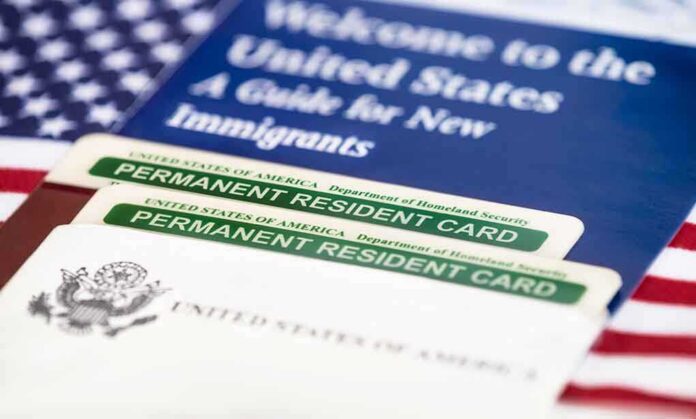
targetdailynews.com — A little-known Trump-era immigration order could quietly push hundreds of thousands of people to pack their bags, leave the United States, and hope their lives are still waiting for them when they get back.
Story Snapshot
- A new rule forces many foreign nationals to leave the United States and apply for green cards through consulates abroad, with narrow exceptions.
- Separate registration and screening mandates expand government databases and raise deportation risks for those who step forward.[1][3]
- The White House frames these moves as restoring “operational control” and enforcing the original intent of immigration law.
- Critics warn of disrupted families, nervous employers, and a quieter squeeze on legal immigration.[4]
How A Technical Rule Change Becomes A One-Way Ticket Home
Most Americans picture immigration fights happening at the border fence, not at a kitchen table in Ohio where a software engineer suddenly learns he may have to fly back to India for months to finish a green card application. Under a policy described in recent reporting, many people in the United States on temporary visas who want permanent residency must now leave and apply through a consulate in their home country, with exceptions only for “extraordinary circumstances.”[5] That sounds technical; in real life, it means uprooting jobs, schools, and mortgages to satisfy a paperwork rule.
The administration’s message is simple: the government is “restoring operational control” over immigration, insisting that people follow the statutory scheme as written and submit to stricter vetting. Supporters argue that requiring consular processing abroad discourages gamesmanship, reinforces the idea that a visa is a privilege, not an entitlement, and allows officers to scrutinize cases without the pressure of an applicant already settled inside the country.[5] That argument resonates with conservatives who believe clear rules only work when they are enforced consistently, not waived whenever someone complains loudly enough.
The Quiet End Of The Shortcut Called Adjustment Of Status
For decades, many immigrants adjusted status from inside the United States, moving from a temporary visa to a green card without leaving the country. That practice made sense for workers in high-demand fields, spouses of citizens, and long-term residents already vetted multiple times. The new policy flips that expectation. News reports describe a Department of Homeland Security memo directing that such applicants should finish their process abroad, treating in-country adjustment as the rare exception, not the rule.[5] Attorneys describe it as a genuine departure from long-standing norms that kept families together during processing.[4]
The administration insists this is not a roundup, but a reset. Officials and allied commentators say the change returns to the “original intent” of immigration law and deters those who might overstay or exploit loopholes.[5] From a common-sense conservative lens, there is a logic here: if you want a green card, you should follow the channel Congress laid out, not invent your own. But the same logic raises a harder question: is it truly necessary to force every nurse, engineer, and small-business employee to leave the country, or could targeted fraud investigations accomplish the same goal with less collateral damage?
Registration, Databases, And The New Architecture Of Enforcement
Parallel to the green card shift, the administration rolled out a separate registration requirement for many immigrants who did not enter with visas. Advocacy groups describe a system where covered individuals must create an online account, submit a detailed biographic form, appear for fingerprinting and photographs, sign government paperwork, and carry proof of registration once background checks are complete.[1][3] Officials can then cross-check these records against criminal and immigration databases and decide who stays and who becomes an enforcement priority. The White House openly touts how it is “accelerating removals” and “pursuing criminal charges against illegal aliens who violate the immigration laws.”
Trump Orders Green Card Renewals to Be Processed Abroad, Forcing Applicants to Leave the US
Washington
President Donald Trump has signed an executive order fundamentally altering the green card renewal process, requiring most foreign nationals seeking to renew their permanent… pic.twitter.com/pr2x05LoYi— Voice of Germany (@NewsVOG) May 23, 2026
Critics call this a trap: step forward, give the government everything it needs to find you, and hope the rules do not change again.[1][6] But the charge only sticks if the government uses that data recklessly. American conservative values emphasize both the rule of law and limited, accountable government. Registration that targets actual criminals and repeat violators is consistent with that. Registration that treats every landscaper and nanny as a suspect starts to look like bureaucracy for its own sake. The policy’s fate depends on where the line is drawn in practice.
Families, Employers, And The Slow Squeeze On Legal Immigration
The raw numbers show why anxiety is high. One immigration lawyer cited in news coverage points to roughly 600,000 people sitting in the green card queue, many of whom could be touched by the new consular requirement. Separately, new financial “public charge” policies and pauses on immigrant visas from dozens of countries labeled high-risk for benefit usage already slow the pipeline.[2] Even without a televised raid, you get a quieter outcome: family reunifications delayed, job offers rescinded, and communities planning around uncertainty instead of growth.
Here, critics sound a warning that deserves attention from anyone who cares about economic dynamism and stable communities. They argue the pattern is not just about law and order; it is about shrinking legal immigration under the radar by making the process so exhausting, expensive, and risky that families give up.[4][6] The administration replies that Americans should not subsidize newcomers who may become dependent or ignore the rules. That concern about taxpayer burden is legitimate. The open question is whether the current suite of rules distinguishes sharply enough between the neighbor who is building a life and the bad actor who is exploiting the system.
Control, Fairness, And What Happens Next
Every immigration fight ultimately lives in the tension between control and fairness. The Trump team emphasizes control: clear lines, tougher screening, denials for those who fail to qualify, and more deportations for those who will not leave on their own.[2] Advocacy groups emphasize fairness: the human cost when a rule written in Washington shreds a plan years in the making.[1][4][6] Both instincts draw on recognizable American values—security on one hand, opportunity and family stability on the other. The danger is pretending you can honor one and ignore the other indefinitely.
Whether this green card rule becomes a footnote or a turning point depends on three things that have not fully surfaced yet: the exact legal language in the Department of Homeland Security memo, the real-world data on how many people are forced out and for how long, and the restraint—or overreach—shown by front-line officers who enforce it.[1][2][6] Until those pieces are visible, one thing is clear. The most consequential immigration battles are no longer just about who jumps the fence. They are about who quietly gets shown the door, paperwork in hand, and told to start over from somewhere else.
Sources:
[1] Web – FAQ: The Trump Immigration Registration Requirement – NILC
[2] Web – Immigration policy of the second Trump administration – Wikipedia
[3] Web – Know Your Rights: Trump’s Registration Requirement for Immigrants
[4] Web – Policy Brief: It Was Never About Unlawful Migration—Attacks on …
[5] YouTube – Trump administration rolls out major change to green card process
[6] Web – Trump Administration Responds to Tragedy By Putting Hundreds of …
© targetdailynews.com 2026. All rights reserved.