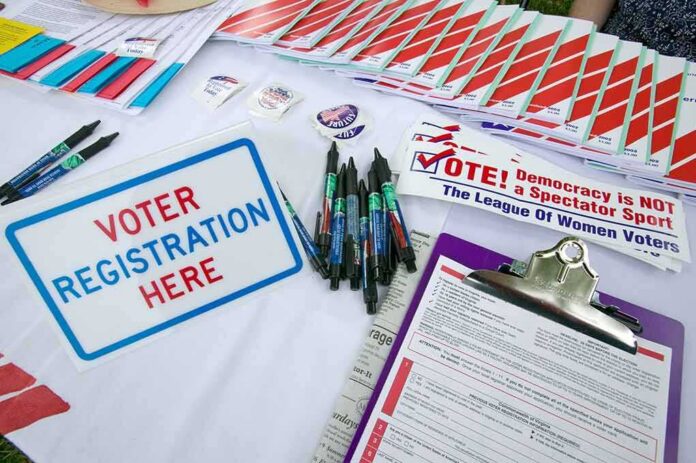
A federal whistleblower says Homeland Security officers were told to skirt state law and build files on “unlawful voters,” even if they were citizens.
Story Snapshot
- A Senate disclosure alleges illegal tactics in a nationwide “Unlawful Voter Initiative”.
- Agents were told to use suspect data and impersonate voters on state portals, the report says.
- Homeland Security touted big numbers, but confirmed far fewer in state-level checks.
- The White House says 278,000 noncitizen registrants exist, based on record matches.
What sparked the whistleblower alarm
Senator Alex Padilla released a whistleblower disclosure alleging Department of Homeland Security and United States Citizenship and Immigration Services leaders diverted fraud detection officers into an “Unlawful Voter Initiative.” The disclosure says they directed officers to use illegal procedures and questionable data to flag “unlawful voters,” including naturalized citizens, and to create federal law enforcement files on them. A companion Senate release said officers were told to impersonate voters to access state election sites and rely on “magic” data that could not be verified.
The New York Times and others reported that hundreds of officers were assigned to scan state voter files using personal details, like dates of birth and partial Social Security numbers, cross-checked against federal immigration records. The Department of Homeland Security argued this effort protected election integrity and said it used public voter data with federal files. The agency framed it as a lawful records match, not a fishing expedition. That claim sits at the center of the clash now testing the boundaries of federal authority and state election control.
How the Nevada numbers set the tone
The project’s credibility took an early hit in Nevada. In July, the Department of Homeland Security said it had identified 15,903 possible noncitizens on the state’s rolls. By mid-August, officials told Nevada they had manually confirmed only 185 noncitizens so far, while more than fourteen thousand needed further review. Local press reported the Department of Homeland Security also sent a separate, unvetted list of thousands that lacked names and included only voter identification numbers, which limited the state’s ability to validate matches.
That sharp drop from headline estimate to confirmed cases raised a basic question: are the matching tools good enough to support large public claims? Data joins across state voter lists and federal immigration files often misfire when names, addresses, and citizenship dates shift over time. Errors can hit naturalized citizens hardest. When the federal government publicizes big, raw counts first, and only later concedes the small verified share, it fuels doubt about both competence and motives.
What the White House and critics each say
The White House posted that a Department of Homeland Security review identified about 278,000 noncitizens registered to vote in federal elections and said the Department of Justice and the Department of Homeland Security were pursuing enforcement nationwide. That figure rests on broad record comparisons, not full case-by-case confirmation. Critics argue such counts overstate the problem because they treat preliminary flags as findings. They point to research and past audits showing noncitizen voting is rare and mass matches are prone to false positives.
Conservatives value both election integrity and the rule of law. Those goals do not conflict. The law must guide how the government checks voter rolls. If officers were told they would not be held responsible for violating state rules, as the whistleblower alleges, that undermines trust and invites legal backlash. If matches produce big numbers but few confirmed cases, that also weakens the case for federal overreach. Tighter methods and transparent validation serve both clean rolls and civil liberties.
Why process matters more than press releases
States run elections. The federal government can support enforcement, but it must respect state access rules and privacy limits. Strong cases come from patient, auditable work: clear legal authority, defined matching standards, and documented verification before any public number goes out. Nevada shows how shortcuts backfire. A splashy estimate, an anemic confirmed count, and murky methods hand critics an easy win and hand defense lawyers a roadmap to toss cases. Process is not red tape; it is armor.
Whistleblower claims that DHS officers used false attestations to query state voter portals under daily quotas have intensified accusations of pre-midterm overreach.
The administration frames the Unlawful Voter Initiative as citizenship verification; Democrats call it an…— Gem Alpha (@Gemalpha_88) September 15, 2026
The path forward looks practical and boring, which is exactly what voters need. Start with state-federal agreements that spell out lawful access. Use conservative matching rules that favor accuracy over volume. Require manual confirmation before publication or referral. Train officers on state election laws and hold leaders to the same standard. Share final numbers only after validation. If the government can prove real cases, it should; if it cannot, it should fix its tools before it speaks. That is common sense, not partisanship.
Sources:
twitchy.com, padilla.senate.gov, rgj.com, theguardian.com, cnn.com, nytimes.com
© targetdailynews.com 2026. All rights reserved.