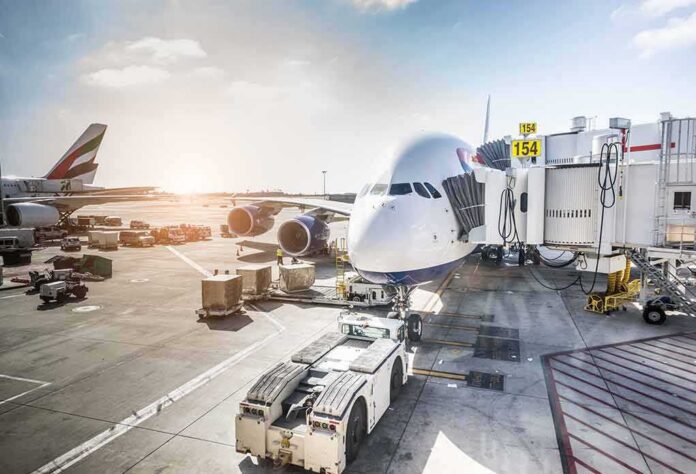
Reports say routine passenger flights carried military cargo to Israel, and the paper trail points to names you know.
Story Snapshot
- Investigations claim United shipped thousands of military loads to Israel on passenger flights.
- An Irish outlet says El Al carried United States-funded munitions through Irish airspace.
- Israel outfitted its civilian airliners with anti-missile defenses years ago, in public view.
- Civil aviation rules allow declared weapons in checked cargo under strict limits, so the practice is not novel.
What the records and routes actually show
The Intercept reported shipping data that tied United to nearly 3,000 loads of military materiel bound for Israel over seven months, moved beneath paying customers on civilian routes. Researchers tracked 2,761 shipments on 160 passenger flights between late July 2025 and late February 2026, describing a return to long-standing practice, not a one-off surge. Reuters separately reported El Al boosted belly cargo and moved over 5,000 tonnes to Israel during wartime demand shocks, signaling scale, not secrecy.
Breaking: Israel Is Using COMMERCIAL AIRLINERS to Move Military Hardware https://t.co/EwKqYCLtNr via @YouTube
— Dorothy Branch (@DottieBRoyael) September 13, 2026
The Irish outlet The Ditch alleged two recent patterns. One story said a United flight carried more than two tonnes of military goods for Elbit Systems under passengers and crossed Irish airspace en route to Tel Aviv. Another said six shipments marked as Foreign Military Financing reached Israel aboard an El Al flight from Newark, also through Irish airspace. These claims cite freight records and official labeling. Irish legal questions sit with Dublin. The logistics facts center on who shipped what, on which flights, and when.
Why this surprises the public but not the industry
Airlines and regulators long allowed declared weapons, parts, and ammunition in checked cargo under strict rules. That includes weight caps, packaging, routing, and carrier consent. The United States code and airline policies carve out how unloaded firearms and certain ammunition move in the hold, not the cabin. That is how modern aviation functions for hunters, law enforcement, and defense suppliers alike. Passenger aircraft and military cargo are not mutually exclusive categories; they intersect under law and paperwork.
Israel’s civil fleet looks even more “dual-use” than most. The government chose Elbit’s C-MUSIC directed infrared countermeasure to protect all Israeli commercial airliners and funded the work years ago. Trade press, company disclosures, and Israeli media covered installs for routes to higher-risk destinations and for national carriers and charters alike. This is defensive gear meant to blind heat-seeking missiles, not move bombs. That public record supports a safety posture, not a smuggling plot.
What is new here is scale and optics, not the mechanism
The scale in the United reporting stands out. Thousands of loads under civilian seats to a war zone reframes the mental picture of a “normal” flight. The Irish airspace angle adds a sovereignty and export-control layer that activists will press, and that states must adjudicate. Yet, from a logistics lens, airlines follow cargo bookings and permits. When passenger demand falls and war lifts freight rates, airlines use every cubic foot their manuals allow. Israel’s flag carrier publicly leaned into cargo during the war, which fits that picture.
Critics argue that mixing tourists and tools of war is wrong on principle. Supporters answer that deterrence and supply speed save lives, and that declared, legal freight on scheduled flights cuts costs and risk. Common sense says both instincts can be true at once. The moral question lands on governments, not check-in agents: who licenses exports, who grants overflight, who pays for lifts, and who ensures compliance every step of the chain.
The prudent questions to ask next
Regulators should publish how they verify that passenger flights carrying military cargo meet packaging and hazard-class rules. Overflight states should state when their permits exclude specific munitions categories and how they enforce those lines. Airlines should disclose, at least in aggregate, how often they carry defense cargo and what thresholds trigger special handling. None of this hands a target map to bad actors. It sets public guardrails that match the reality already in the air.
Breaking: Israel Is Using COMMERCIAL AIRLINERS to Move Military Hardware https://t.co/KZivbyLL7L
— Fion Mor (@terri5464689066) September 13, 2026
For Israel, the through-line is consistency. The state hardened civilian jets with countermeasures well before today’s headlines. It also relies on a web of commercial and military lift, including new Boeing KC-46 tankers that can carry cargo and passengers together for the Israel Defense Forces, a detail the military itself highlights. If the paperwork is clean and routes are lawful, then the practical debate shifts from “did this happen” to “should this be the default.” On that, voters and courts will have the last word.
Sources:
youtube.com, theintercept.com, en.wikipedia.org, zona-militar.com, israeldefense.co.il, aerospaceglobalnews.com, en.globes.co.il
© targetdailynews.com 2026. All rights reserved.