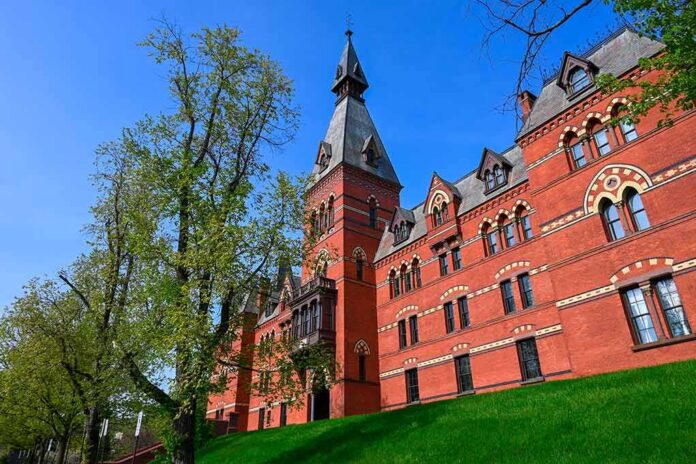
Cornell will award a bachelor’s degree inside a New York prison, with classes starting in 2027 and a defined major ready to go.
Story Snapshot
- Cornell plans a Bachelor of Professional Studies at Cayuga Correctional Facility in 2027.
- The major, Organizations, Markets, and Society, blends economics, policy, and business skills.
- Applicants need an associate degree or about 60 credits; the first cohort will be small.
- The degree builds on years of Cornell-taught prison courses and reentry support plans.
Cornell fixes a start date, a degree, and a campus inside prison
Cornell University’s Prison Education Program set a firm launch for a Bachelor of Professional Studies at Cayuga Correctional Facility beginning Fall 2027. The program is housed in Cornell’s School of Continuing Education and will run in person at the state facility. Cornell states the major is Organizations, Markets, and Society, which targets real-world decision making across work and civic life. The Cornell Daily Sun reported Cornell will be the first Ivy League school to offer a degree in prison.
The plan goes beyond a pilot seminar or loose coursework. Cornell published an academic home, a location, a degree title, and a start term. That specificity matters. It signals that curriculum design, credit structures, and governance have moved past the concept stage. The program promises a three-year pathway for students who enter with an associate degree or roughly 60 college credits. Applicants may need to transfer to Cayuga to join the cohort, per Cornell’s materials and student guides.
What students will study and why it was chosen
The curriculum spans economics, management, finance, entrepreneurship, data analysis, public policy, global development, and social inequality. That mix blends professional skills with social science depth. Students will read markets and organizations as systems, learn how rules and incentives shape behavior, and practice decisions with real tradeoffs. Cornell frames the major as training for life after release and for leadership inside the facility classroom. The program’s pages outline these topics and their course families.
Cornell links this launch to years of instruction behind the wall. Faculty, graduate students, and undergraduates already teach accredited courses at Auburn, Cayuga, and Five Points correctional facilities. Those classes have fed associate degrees through SUNY Cayuga Community College and a Cornell liberal arts certificate for a smaller group. That record shows logistics, classroom routines, and credit transfer can work in that setting at scale over time, which lowers the risk for a bachelor’s build-out.
Who can apply and how the degree will run
Cornell says students with an associate degree can apply, and the degree should take about three years of study. The Cornell Daily Sun reported that applicants may also qualify with at least 60 credits and might need a transfer to Cayuga to enroll. The first cohort is expected to be small, roughly 12 to 18 students. The School of Continuing Education is adapting paper-based applications for the prison setting. Faculty assignments are still being finalized for the degree rollout.
The degree operates inside a prison, so rules on movement, materials, and schedules will shape class life. Cornell’s program design emphasizes in-person teaching, clear credit mapping, and support services. Cornell also points to academic reentry support for alumni after release, aiming to help with school continuation and work searches. Earlier this year, Cornell announced a one and a half million dollar award to build a national research hub tied to prison education, which can also inform quality control and outcomes tracking.
Quality questions that matter and why outcomes will be watched
The first classes start in 2027, so no graduates exist yet. That means results on employment or recidivism will come later. Cornell can strengthen public trust by publishing the full curriculum, syllabi, assessment policies, and instructor rosters before day one. That transparency matches how serious colleges treat new degrees. It also respects taxpayers and donors who want value and real accountability. A clear benchmark lets anyone check if prison-based learning matches Cornell’s on-campus standards.
Research on correctional education shows strong reasons to try. A RAND analysis found that people who took education in prison had lower odds of returning to prison and higher odds of getting a job after release. RAND also reported savings for every dollar invested due to reduced reincarceration costs. Those numbers do not prove results for this specific degree. They do explain why a rigorous, well-run program could deliver both human and public-safety benefits if Cornell executes well.
Sources:
nypost.com, cpep.cornell.edu, experience.cornell.edu, rand.org
© targetdailynews.com 2026. All rights reserved.