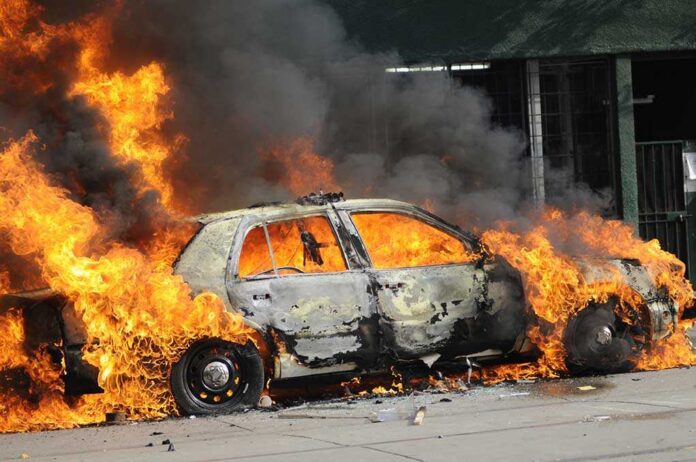
A plumber started his car on a quiet New Jersey street Monday morning, and the vehicle exploded with enough force to blow debris into neighboring homes across the road.
Story Snapshot
- A car exploded at 5:40 a.m. on Congressional Lane in Totowa, New Jersey, injuring the driver and damaging nearby townhomes.
- Authorities believe a leaking acetylene tank in the trunk ignited when the driver started the vehicle.
- The Bureau of Alcohol, Tobacco, Firearms and Explosives and a bomb squad ruled out any criminal device.
- The investigation is ongoing, and no official final cause has been released as of July 13, 2026.
A Blast That Woke Up the Whole Block
The explosion happened just before sunrise on a residential street in Totowa, a small borough in Passaic County. A 28-year-old man got into his car, turned the key, and the vehicle detonated. Debris flew across the street and struck neighboring homes. Neighbors described it as a concussive blast with no fire — the kind of boom that rattles windows and pulls people out of bed. Emergency crews arrived quickly, and the injured man was taken to a hospital.
Totowa Mayor John Coiro told reporters the victim is a plumber who had an acetylene tank stored in the trunk of his car. Coiro said the tank was visible in post-explosion photos. First responder radio traffic captured by News12 New Jersey also named acetylene and noted the driver had just started the vehicle when it ignited. That kind of detail — scanner audio naming the gas and the ignition moment — is hard to dismiss as speculation.
What Investigators Believe Happened
Officials believe the acetylene tank was leaking before the driver got in the car. Acetylene is a highly flammable gas used in welding and cutting work. When it leaks into a confined space like a trunk or passenger cabin, it only takes a small electrical spark to set it off. Starting a car creates exactly that kind of spark. The Bureau of Alcohol, Tobacco, Firearms and Explosives examined the scene and, along with the bomb squad, ruled out any explosive device. That finding alone narrows the cause considerably.
This type of accident is not new. A similar explosion destroyed a service van in British Columbia after an oxyacetylene welding system leaked overnight and ignited from an electrical spark. In Holden, Massachusetts, a man was seriously injured when an acetylene tank leaked in his car and exploded — and investigators there noted the blast caused no significant fire, just like in Totowa. The no-fire detail that puzzled Totowa neighbors is actually consistent with how acetylene explosions behave in enclosed spaces.
What Is Still Not Confirmed
Mayor Coiro was careful with his words. He said “preliminarily, we’re not sure” if the acetylene tank caused the explosion. No forensic lab report has been released. No photos of the tank have been made public, even though Coiro said the tank was visible in on-scene images. There is also a small conflict in the reporting — CBS News and News12 identify the victim as a plumber, while WABC identifies him as a welder. That matters because it affects how routine an acetylene tank in his trunk would be. Both plumbers and welders can use acetylene, but the inconsistency is worth noting.
ALERT: Small town in New Jersey was rocked this morning after a plumber got in his car and it exploded.
Residents in Totowa were awakened at around 5:40 AM to the sound of a car explosion.
Officials believe an acetylene tank, a highly flammable gas used for welding, was slowly… pic.twitter.com/KEOUgjnI7M
— E X X ➠A L E R T S (@ExxAlerts) July 13, 2026
No one has offered a credible alternative explanation. A social media comment suggested a fuel pump gasket failure, but that idea has no evidence behind it and no expert support. The Bureau of Alcohol, Tobacco, Firearms and Explosives ruling out a bomb, combined with scanner audio naming acetylene at the scene, gives the preliminary theory a solid foundation. The open question is not really whether acetylene caused this — it is when the official report will confirm it in writing and close the loop for the public and for the victim’s neighbors who are still picking debris out of their yards.
The Bigger Warning for Tradespeople
Acetylene tanks are common tools on job sites. They are also among the most dangerous gases to store improperly. The gas is unstable at high pressure and leaks silently. A tank left in a closed trunk overnight can fill the space with enough gas to explode from a single spark — including the tiny spark a car’s ignition system produces every time someone turns a key. Proper storage means keeping tanks upright, secured, and never in an enclosed vehicle compartment. This Totowa explosion is a hard reminder that the rules around compressed gas exist for a reason, and ignoring them can turn a Monday morning commute into a catastrophe.
Sources:
facebook.com, rlsmedia.com, newjersey.news12.com, cbsnews.com, youtube.com
© targetdailynews.com 2026. All rights reserved.