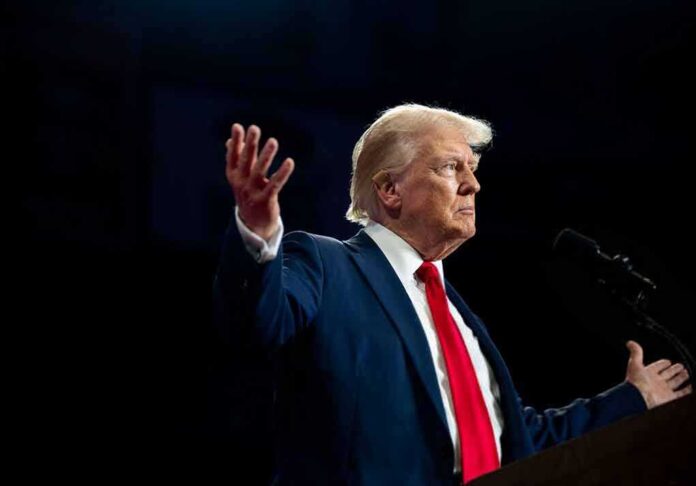
The first U.S. order to resume nuclear weapons testing since 1992 has just shattered decades of global restraint, and the world is waiting to see if this is the moment that reignites a nuclear arms race.
Story Snapshot
- President Trump has directed the Pentagon to restart nuclear weapons testing, breaking a 33-year moratorium.
- The announcement precedes a diplomatic summit with China, intensifying already fraught international relations.
- The stated rationale is to match rival powers, despite no recent Russian or Chinese tests.
- Experts warn the decision risks destabilizing nonproliferation efforts and could trigger global consequences.
Trump’s Directive: Breaking the Nuclear Silence
President Donald Trump announced on October 30, 2025, via his social media platform that he has ordered the U.S. Department of Defense to resume nuclear weapons testing “on an equal basis” with other nations. This move ends a moratorium that began in 1992, when the U.S. last conducted such a test. The decision arrives at a critical juncture, just before Trump’s scheduled meeting with Chinese President Xi Jinping at the Asia-Pacific Economic Cooperation summit in South Korea, a setting already charged with diplomatic tension.
Trump’s statement frames the directive as a response to nuclear advancements by Russia and China, despite neither country having conducted a test since the 1990s. North Korea is the only nation to have broken the global moratorium in recent years. The announcement is unprecedented in modern U.S. history, representing the first presidential order to resume nuclear testing in more than three decades, and it signals a dramatic shift in American nuclear policy.
Historical Context and Geopolitical Stakes
The United States, Russia, and China have maintained an unspoken agreement not to conduct nuclear tests, guided by the Comprehensive Nuclear-Test-Ban Treaty (CTBT) established in 1996. While all three have signed the treaty, none have ratified it, a technicality that allowed the moratorium to persist without legal binding. The last U.S. test occurred in 1992, China’s in 1996, and Russia’s in 1990. Over the past two decades, only North Korea has defied this global norm, conducting several nuclear tests and drawing near-universal condemnation.
The context for Trump’s announcement is defined by rising tensions with China and Russia, particularly around nuclear modernization and strategic parity. By choosing the eve of a major diplomatic summit for his message, Trump injects nuclear policy into the heart of international negotiations. Defense officials now face the complex task of operationalizing the directive, balancing technical feasibility, strategic necessity, and the potential diplomatic fallout.
Immediate Reactions and Potential Fallout
The Pentagon is already preparing to implement the order, though no specific test dates or locations have been released. The decision is expected to provoke swift international and domestic responses. Allies may view the move as destabilizing, while adversaries could interpret it as an escalation. Within the U.S., anti-nuclear groups and legal experts are expected to challenge the order, arguing it undermines decades of nonproliferation leadership.
Experts in arms control warn that resuming nuclear testing could trigger a new arms race, with other nuclear powers potentially following suit. The erosion of the moratorium may have long-term consequences, including the undermining of the CTBT and the weakening of the global nonproliferation regime. Populations near potential test sites, such as the Nevada Test Site, could face renewed risk, and defense contractors may see a surge in activity as infrastructure modernization becomes a priority.
The Debate: Security, Deterrence, and Political Motives
Proponents of renewed testing argue that matching the nuclear programs of rivals is essential for deterrence and technological superiority. They claim that the U.S. must demonstrate its capabilities to maintain strategic parity. Critics counter that there is no technical necessity for live tests, given robust stockpile stewardship programs that ensure reliability without detonations. Legal analysts highlight that while the U.S. has not ratified the CTBT, resuming tests violates its spirit and damages American credibility.
Scholars suggest the timing and framing of the announcement indicate a political motive, designed to project strength and influence negotiations. The rationale for the order cites “other countries testing programs,” yet current evidence confirms that only North Korea has conducted recent tests. The Legion.org report and United Nations documentation corroborate these facts, emphasizing that the move is not a direct response to new actions by Russia or China.
Sources:
Legion.org: Trump Orders Pentagon to Match Other Nations Nuclear Testing