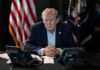
targetdailynews.com — When a seven-term congressman who never said an unkind word about Donald Trump still loses his seat by double digits, something significant is happening inside the Republican Party.
Story Snapshot
- Trump-backed Ed Gallrein defeated incumbent Representative Thomas Massie in Kentucky’s Republican primary by roughly 10 points, with Defense Secretary Pete Hegseth personally campaigning against Massie.
- Trump-endorsed candidates swept Indiana GOP primaries, knocking out state senators who had blocked Trump’s redistricting agenda.
- Republican primary wins for Trump-backed candidates also materialized across Ohio, Michigan, Georgia, Alabama, and Pennsylvania in the same cycle.
- The Kentucky race became the most expensive congressional primary on record, with over $35 million spent, raising real questions about whether the endorsement or the money drove the result.
The Kentucky Race Was a Loyalty Test Dressed as an Election
Thomas Massie is no liberal. He is a libertarian-leaning, constitutionally principled conservative who voted against foreign aid packages and massive spending bills. He did not vote to impeach Trump. He did not campaign against him. Yet Trump called him “the worst congressman in the history of our country” and threw the full weight of his political operation behind a challenger named Ed Gallrein, a candidate most Kentucky voters had never heard of before Trump’s endorsement made him a household name overnight. [5]
Gallrein won by approximately 10 points with 99 percent of votes counted, and Massie conceded on air. [5] Defense Secretary Pete Hegseth showed up in the district to campaign against the sitting congressman, framing Massie’s independent streak as a liability to the movement rather than a feature of principled governance. That a cabinet secretary was deployed to unseat a Republican incumbent tells you everything about how seriously the Trump operation takes primary enforcement. [5]
Indiana Showed the Same Pattern Weeks Earlier
The Kentucky result did not happen in a vacuum. In Indiana, Trump-endorsed challengers defeated multiple state senators who had stood in the way of his redistricting priorities. Five of the Trump-backed candidates won their races, with only one incumbent surviving the challenge. Fox News described the results as “another sign that his immense grip on the Republican Party remains rock solid.” [1] Whether you call that grip loyalty or fear probably depends on which side of the primary you were standing on.
The Indiana results reinforced a pattern already visible across the Midwest. In Ohio and Michigan, Republican candidates endorsed by Trump also secured victories in their respective primaries. [2] The geography matters here. These are not deep-red southern states where Trump’s base is culturally dominant by default. These are competitive industrial states where winning a primary requires actual organizational effort, not just name recognition.
The Money Question Nobody Wants to Answer
Massie himself offered a pointed counter-narrative in his concession. He described the Kentucky race as an attempt to “buy” his congressional seat, pointing to donors including Miriam Adelson and Paul Singer as major financial forces behind the challenge. [5] With over $35 million spent in a single House primary, the sheer volume of outside money creates a legitimate alternative explanation for the outcome. Was it Trump’s endorsement that moved voters, or was it a months-long, nine-figure advertising campaign that made an unknown challenger look inevitable?
Trump-backed Republicans dominated primaries in KY, GA, PA, and AL. Key wins include Ed Gallrein defeating Thomas Massie and Andy Barr winning the Senate primary. #GOP #Elections pic.twitter.com/eTUWaORiVq
— Mia (@Mia_MMMiaaa) May 20, 2026
The honest answer is probably both, and that distinction matters more than partisans on either side want to admit. Political science has consistently found that endorsements carry the most weight in low-information environments where voters have few other cues. When a race is already saturated with advertising, opposition research, and national media coverage, the endorsement becomes one signal among many rather than the decisive factor. The Massie race was anything but low-information by the time voters went to the polls.
What the Primary Sweep Actually Proves About Republican Politics
Across the full arc of Trump-backed primary activity, from the 2024 presidential primary sweep through states including Iowa, New Hampshire, South Carolina, Ohio, Pennsylvania, and Indiana [3], to the 2026 cycle results in Kentucky, Georgia, Alabama, and beyond, the pattern is consistent enough to be taken seriously. Trump’s endorsement does not guarantee a win in every contest, but it reliably reframes every race it enters. A previously local contest becomes a national referendum on loyalty, outside money floods in, and the incumbent is forced to defend votes that were never meant to be campaign issues.
That is a form of political power regardless of whether the endorsement itself is the causal engine. Trump-backed Andy Barr also won the Republican nomination for Mitch McConnell’s Senate seat in Kentucky, adding another high-profile scalp to the cycle’s tally. [7] The cumulative effect across Indiana, Kentucky, Georgia, and the broader Midwest is a Republican caucus that understands, with crystal clarity, what crossing Trump costs. Whether that produces better governance or simply more compliant governance is the question the 2026 general election will begin to answer.
Sources:
[1] Web – Trump wins big in Indiana GOP primaries with endorsed challengers
[2] YouTube – Trump backed candidates win primaries
[3] Web – 2024 Republican Party presidential primaries – Wikipedia
[5] YouTube – Thomas Massie loses Kentucky Republican primary against Trump …
[7] YouTube – Trump-backed Andy Barr wins GOP nomination for …
© targetdailynews.com 2026. All rights reserved.