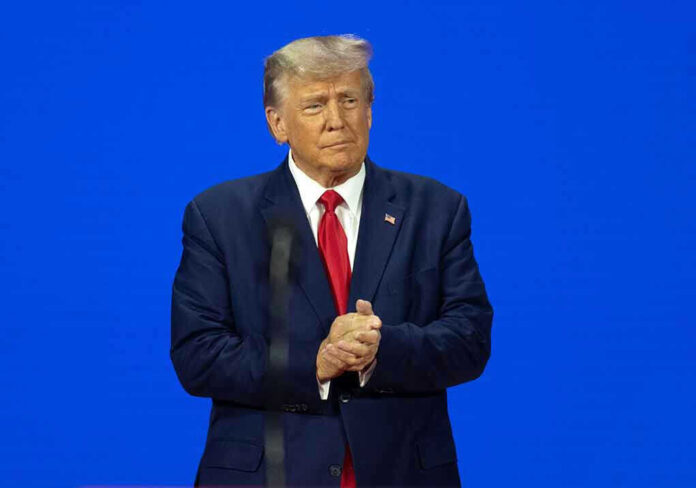
When President Trump tied a $40 billion lifeline to an Argentine politician’s election results, he wasn’t just making foreign policy—he was betting America’s credibility on a chainsaw-wielding economist’s radical experiment in one of the world’s most economically volatile nations.
Story Highlights
- Javier Milei’s party captured over 40% of Argentina’s midterm vote, more than doubling congressional seats
- Trump’s administration tied $40 billion in financial support directly to Milei’s electoral performance
- The victory provides political capital for accelerated economic reforms but requires coalition-building
- Argentina recorded its lowest voter turnout since returning to democracy at just 67.9%
- Peronist opposition faces its weakest institutional position in recent memory
Trump’s Financial Gamble Pays Off
The Trump administration’s unprecedented intervention in Argentine politics materialized through a $20 billion currency swap line and another $20 billion loan instrument announced just days before the October 26 vote. This wasn’t subtle diplomacy—it was economic statecraft with American credibility on the line. Financial markets had been rattled after Milei’s party suffered a 14-percentage-point loss in Buenos Aires provincial elections just two months earlier.
The timing proved masterful. Milei’s La Libertad Avanza party not only exceeded expectations but secured narrow victory in Buenos Aires Province, the very region where they had stumbled badly in September. UBS Managing Director Alejo Czerwonko noted the victory “sits at the most optimistic end of pre-election expectations,” giving Milei “the political capital needed to accelerate structural reforms.”
The Chainsaw Strategy Goes Mainstream
Milei’s signature campaign prop—a chainsaw representing cuts to government spending and bureaucracy—has evolved from political theater into governing reality. His libertarian economic philosophy stands in stark contrast to Argentina’s traditional Peronist interventionism, yet Argentine voters embraced the pain of economic adjustment for promises of long-term stability. The electoral mandate validates his inflation-fighting agenda and structural reform plans.
However, the victory creates an ironic twist for a president who campaigned against “the caste.” Milei now must negotiate with the very political establishment he scorned to advance sweeping reforms. His party achieved the crucial one-third congressional threshold for blocking power, but building legislative majorities requires agreements with centrist and provincial blocs.
Peronist Collapse Opens Political Space
The traditional Peronist Partido Justicialista faces its weakest institutional position in decades, with internal conflicts erupting immediately after the poor electoral showing. Former President Cristina Fernández de Kirchner’s conviction and imprisonment symbolizes the movement’s declining influence. Political analyst Alejandro Catterberg observed that “Peronism is at its weakest point in terms of institutional power in a long time.”
This political vacuum provides Milei extraordinary maneuvering room, yet provincial governors retain significant power and control key congressional segments. Many governors suffered local setbacks but maintain popularity in their regions, making them essential negotiating partners for reform legislation. The Atlantic Council’s Jason Marczak characterized the Buenos Aires Province victory as the “most surprising” result given the previous devastating loss there.
Historical Echoes and Future Risks
Argentina’s economic history casts long shadows over Milei’s experiment. The 1990s liberalization under President Carlos Menem initially promised transformation but ended in crisis after a decade of overreach and debt. Experts traveling to Buenos Aires today report the same mixture of “optimism and unease” that characterized that earlier period. The fundamental question remains whether Milei can reform fast enough to restore confidence without precipitating collapse.
The concerning sign of 67.9% voter turnout—the lowest since Argentina’s return to democracy—suggests potential civic disillusionment even amid Milei’s victory. This apathy could either provide political space for difficult reforms or indicate dangerous disconnection between government and citizens. The Trump administration now finds itself financially and politically exposed, with Washington’s credibility tied directly to an untested economic experiment in South America’s second-largest economy.
Sources:
Milei Just Got a Midterm Boost. What’s Next for Argentina?
Milei’s Decisive Midterm Election Victory