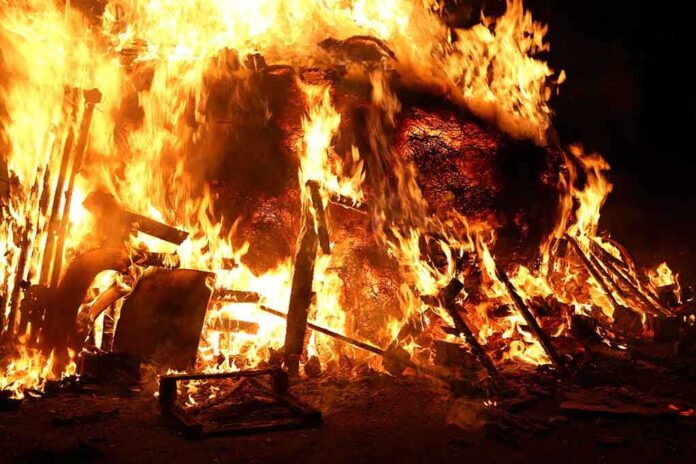
One year after the devastating Palisades Fire, residents still battle toxic soil contamination, insurance denials, and government bureaucracy while officials who failed them remain unaccountable for the systematic negligence that left communities defenseless.
Story Snapshot
- Alleged arsonist Jonathan Rinderknecht sparked fire on New Year’s Day 2025, reignited by 100 mph winds on January 7
- Government failures included non-functioning fire hydrants, abandoned firebreaks, and deactivated early warning sensors
- FEMA approved aid quickly, but Cal OES delayed processing for weeks due to contractor outages, leaving 80% of uninsured homeowners stranded
- FireAid concert raised $100 million but controversy erupted over funds going to nonprofits instead of directly helping victims
Arson Sparked Catastrophic Chain of Events
Jonathan Rinderknecht, an Uber driver, allegedly started the fire at Skull Rock Trailhead around midnight on January 1, 2025, by discarding a cigarette. He called 911 at 12:17 a.m. and later queried ChatGPT about liability for starting fires. Firefighters suppressed the initial blaze but failed to fully extinguish it, leaving equipment onsite. The fire reignited on January 7 during the driest nine-month period on record, exploding from 10 acres to 1,262 acres amid 80-100 mph Santa Ana winds.
The reignition occurred at 10:30 a.m. near Pacific Palisades, quickly overwhelming response capabilities. Governor Gavin Newsom toured the site while Mayor Karen Bass declared a local emergency at 7:58 p.m. By January 8, over 100,000 residents faced evacuation orders as flames spread into Pacific Palisades and Topanga. The fire became part of 12 simultaneous Southern California fires that ultimately killed 32 people across the region.
Infrastructure Failures Exposed Government Negligence
Critical infrastructure collapsed when residents needed it most, exposing years of government negligence. Fire hydrants failed throughout the affected areas, leaving firefighters without adequate water pressure during peak demand. County officials had abandoned firebreak maintenance programs and deactivated early warning sensors that could have provided crucial advance notice. These systematic failures turned a manageable situation into a catastrophe that destroyed entire neighborhoods.
The Los Angeles Department of Water and Power and LA County now face multiple lawsuits for their role in the disaster. Residents argue that proper infrastructure maintenance could have prevented much of the destruction. The abandoned firebreak programs, in particular, eliminated crucial defensive barriers that had protected communities in previous fire seasons. These cost-cutting measures prioritized budget savings over public safety, leaving residents vulnerable to exactly this type of wind-driven fire event.
Bureaucratic Delays Compounded Victims’ Suffering
While FEMA approved federal aid on January 15, California’s Office of Emergency Services delayed processing assistance for weeks due to contractor outages. This bureaucratic failure left 80% of uninsured homeowners waiting for damage assessments they desperately needed to begin rebuilding. Community town halls on January 26 erupted with resident outrage over the slow response and inadequate support systems.
The FireAid concert raised $100 million on January 30, but controversy emerged over fund distribution. Critics discovered that money flowed to nonprofit organizations rather than directly to fire victims, sparking additional outrage in July 2025. Meanwhile, the US Army Corps of Engineers completed 90% of debris removal by July, though progress was slowed by environmental regulations and difficult terrain. Toxic soil contamination containing lead and arsenic remains unaddressed for many properties, creating ongoing health risks for families trying to return home.
Sources:
Palisades Fire Timeline of Key Events and Failures
FSRI Timeline: How 2025 SoCal Wildfires Spread and Killed 32