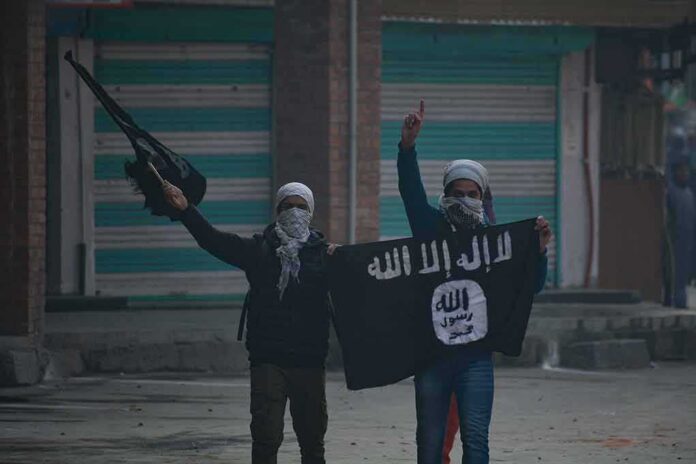
The Islamic State has issued coordinated worldwide calls for lone-wolf terrorists to shoot, stab, ram, and burn Christians and Jews in their places of worship during Easter and Passover celebrations.
Story Snapshot
- ISIS spokesman Abu Hudhaifa al-Ansari released recordings in March 2024 calling for attacks on Christians and Jews across the United States, Europe, and Israel
- April 2026 propaganda specifically targeted Easter weekend with calls for arson attacks on churches and synagogues worldwide
- The terror group now operates as a decentralized franchise model across Africa, Afghanistan, the Philippines, and other regions after losing territorial control
- ISIS frames these attacks as retaliation for Israeli operations in Gaza and broader conflicts affecting Muslim populations
- Security experts warn the organization maintains capability and intent to inspire mass-casualty attacks in Western territories despite territorial losses
The Deadly Easter Message That Changed Threat Assessments
ISIS released propaganda in early April 2026 calling for coordinated arson attacks on churches and synagogues during Easter weekend. The timing was deliberate. Religious gatherings create target-rich environments where maximum casualties can be achieved. Security services across Europe and the United States immediately elevated threat levels. The calls represented a shift from generic violence appeals to temporally coordinated campaigns exploiting specific religious observances. Intelligence agencies scrambled to identify potential lone-wolf attackers inspired by the messaging, but the decentralized nature of modern terrorism makes prevention extraordinarily difficult.
From Caliphate to Franchise: How ISIS Transformed After Territorial Collapse
The Islamic State proclaimed itself a worldwide caliphate in 2014, claiming religious authority over all Muslims. Between 2013 and 2019, ISIS controlled significant territory across Iraq and Syria. Then came the collapse. By 2019, coalition forces had stripped away most territorial holdings. Rather than disappearing, ISIS transformed into something more insidious: a franchise operation. Regional branches now operate semi-autonomously across the Sahel, Afghanistan, Somalia, Syria, Iraq, and the Philippines. Each franchise conducts operations aligned with central ideology while adapting tactics to local conditions.
ISIS leadership publicly praised operatives for devastating attacks: the January 2024 Kerman bombings in Iran, the March 2024 Crocus City Hall massacre in Russia killing hundreds, and various regional operations. The decentralized structure makes the organization harder to dismantle through traditional military means. You cannot bomb an ideology into submission. The franchise model allows ISIS to maintain operational relevance globally despite lacking territorial control. Security analysts initially believed this transformation reduced threats to the United States compared to Europe, but recent assessments reveal that conventional wisdom was dangerously wrong.
The Propaganda Machine Targeting Western Muslims
ISIS spokesman Abu Hudhaifa al-Ansari released recordings on March 28, 2024, calling for lone-wolf attacks against Christians and Jews in the United States, Europe, and Israel. The message praised the Moscow attack days earlier and provided explicit tactical guidance: shootings, stabbings, vehicle rammings, bombings, and arson. The propaganda deliberately frames conflicts as religious warfare between Muslims and “infidels,” attempting to polarize Muslim populations in Western countries. The strategy seeks to drive wedges between Muslim communities and their governments, making the caliphate ideology more appealing.
ISIS justifies these calls as retaliation for Israeli military operations in Gaza and broader Muslim suffering in Palestine, Iraq, Syria, Burma, India, and China. The grievances are deliberately expansive, providing justification for violence anywhere at any time. Regional franchises receive specific praise for targeting Christians in Africa, attacking Americans and Russians in Afghanistan, and turning the southern Philippines into an operational base. This messaging is designed to inspire opportunistic attacks by individuals without formal organizational ties, creating an unpredictable threat landscape that challenges traditional counter-terrorism approaches.
Why Churches and Synagogues Became Primary Targets
The April 2026 Easter messaging represented unprecedented specificity in target selection and timing. ISIS called for attacks on places of worship during major religious gatherings when congregations would be largest. Churches and synagogues are soft targets with limited security infrastructure. Worshippers gather in predictable patterns during well-known holidays. The symbolism amplifies the terror: attacking people in sacred spaces during holy celebrations maximizes psychological impact beyond the immediate casualties. Security experts note this represents a deliberate strategy to exploit religious gatherings and create self-fulfilling prophecies of religious polarization.
The Uncomfortable Truth About Ongoing Capabilities
Brookings Institution analysts acknowledged that conventional wisdom underestimated ISIS threats to the United States. The organization demonstrated capability and intent to conduct sophisticated attacks in Western territories through videos threatening Paris-style attacks on Washington, D.C. Previous attacks proved the threat was real: November 2015 Paris massacres, the 2024 Kerman bombings, the March 2024 Moscow theater attack, and reported 2025 incidents at Bondi Beach and a Manchester synagogue on Yom Kippur. While specific plots require verification by security services, the pattern is undeniable.
The franchise model creates persistent terrorism risks that will endure for years. ISIS maintains operational capability across multiple geographic regions despite losing its territorial caliphate. The decentralized structure allows continued radicalization of vulnerable individuals through online propaganda. Religious institutions face elevated threat levels requiring enhanced security protocols that fundamentally alter the accessibility and atmosphere of worship spaces. The balance between civil liberties and security measures creates ongoing policy challenges for Western governments. The Easter 2026 threats represent the latest chapter in a conflict that shows no signs of resolution, only evolution in tactics and targeting as ISIS adapts to maintain relevance in a post-territorial existence.
Sources:
ISIS Calls for ‘Shoot, Stab, and Ram’ Attacks on Christians and Jews in UK – European Conservative
ISIS Calls for Attacking Christians and Jews Everywhere – Terrorism-Info.org.il
We Were Wrong About ISIS – Brookings Institution
ISIS Urges Worldwide Attacks on Churches and Synagogues at Easter – Premier Christian News