What happens when a city’s skyline is erased, not by time, but by relentless war—leaving only drone-captured echoes of a civilization flattened beneath the dust?
Story Snapshot
- Drone footage reveals Gaza City almost entirely destroyed after two years of conflict.
- Entire neighborhoods transformed into rubble, reshaping the city’s identity and future.
- Images offer a new perspective on the scale of urban devastation and human loss.
- Ongoing war between Israel and Hamas continues to shape the landscape and lives in Gaza.
The Ruins Seen From Above: Gaza’s Vanished Cityscape
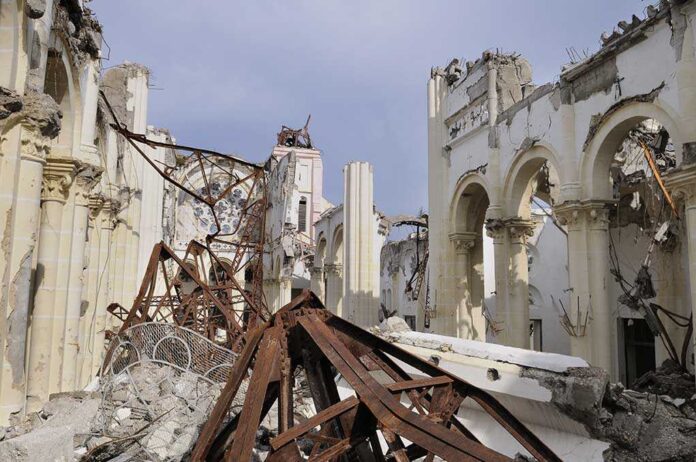
Drone cameras flying above Gaza City today capture a scene almost unrecognizable to those who once called it home. The city’s once-crowded neighborhoods have become a bleak patchwork of collapsed buildings, concrete dust, and twisted rebar. In every direction, rows of flattened structures replace what were schools, homes, and markets—now reduced to indistinct piles of debris. The aerial perspective exposes not just physical destruction, but the magnitude of loss that ground-level photos could never convey. The drone’s eye shows the new normal: a cityscape erased, its former life only traceable in broken outlines and empty streets.
Residents who survived the bombings now navigate streets bordered by ruins, searching for salvageable belongings or simply a sense of orientation in a city that no longer resembles the maps in their memories. The mosaic of destruction, so total in some areas, forces the question: what happens to a society when its physical anchors—homes, neighborhoods, familiar landmarks—are obliterated? Gaza’s transformation is more than a local tragedy; it is a cautionary tale about the cost of protracted urban warfare, visible now to the world in unprecedented detail through drone technology.
The Human Toll Behind the Rubble
Towering piles of rubble are not only evidence of artillery and airstrikes—they are a silent record of families displaced, lives interrupted, and histories erased. For many, the loss is not just structural, but deeply personal: wedding photos buried under concrete, childhood bedrooms reduced to dust. The city’s fabric, built over generations, has been torn apart in months. Survivors recount stories of fleeing with little more than the clothes on their backs, leaving behind entire lives compressed into shattered masonry. The footage underscores a reality that numbers cannot: each ruined block hints at countless individual tragedies.
Humanitarian agencies warn that the physical devastation compounds a dire crisis for the hundreds of thousands left homeless. Makeshift shelters and overcrowded relief centers now dot the periphery, while essential services—water, electricity, schools—remain inaccessible for many. The drone footage provides a visual inventory of challenges facing any future reconstruction: not only must buildings be rebuilt, but communities must be reknit from the shared trauma and loss. The psychological scars, less visible than the ruins, loom over Gaza’s uncertain future.
The Ongoing War and What Comes Next
Two years into the conflict, the war between Israel and Hamas shows no signs of resolution. Each strike and counterstrike further transforms Gaza’s landscape, making recovery and stability a distant hope. The drone images serve both as evidence and warning—highlighting how modern warfare, with its overwhelming firepower and urban settings, leaves little untouched. International observers debate the feasibility of large-scale reconstruction, but the scale of destruction visible from the air suggests that rebuilding Gaza City will require not just resources, but also a sustained commitment to peace and reconciliation—commodities as scarce as intact buildings in the current landscape.
For now, the city’s future remains in limbo, suspended between the memory of what was and the uncertainty of what can be. The drone’s lens has become the archive of a place that once bustled with life, now suspended in a state of aftermath. As the world watches, the question persists: when so much is lost, what does it take to rebuild—not just structures, but hope itself?
Sources:
Drone footage shows Gaza before and after war in shocking scale of destruction