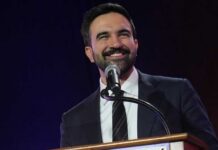
Gavin Newsom has positioned himself as the Democratic Party’s most formidable contender for 2028, and Politico’s recent declaration of his frontrunner status signals what insiders have quietly known for months: the California governor is playing a different game than his potential rivals.
Quick Take
- Politico named Gavin Newsom the Democratic frontrunner for 2028, citing his national visibility and political infrastructure as decisive advantages over competing candidates
- Newsom has systematically built a national network through strategic policy victories, international appearances, and a forthcoming memoir designed to elevate his profile before the 2026 midterms
- His fundraising prowess and organizational readiness position him as the most prepared Democrat for a presidential run, despite competition from figures like Pete Buttigieg and Andy Beshear
- The governor has signaled he will seriously consider a presidential campaign after the 2026 midterm elections, giving him time to consolidate support and shape party direction
The Architecture of Ambition
Newsom’s path to frontrunner status wasn’t accidental. Over the past two years, he has methodically constructed the machinery of a presidential campaign without formally declaring candidacy. His successful push for Proposition 50, which expanded his influence over California’s political apparatus, demonstrated his ability to mobilize resources and execute complex political operations. Simultaneously, he has cultivated relationships with major donors, labor unions, and environmental groups—the financial and organizational backbone of any serious presidential bid.
What separates Newsom from other potential contenders is his willingness to operate on a national stage while maintaining firm control of his home state power base. Unlike candidates who must choose between local and national priorities, Newsom has leveraged California’s size and influence to do both simultaneously. His campaign infrastructure, according to political insiders, is already calibrated for a presidential race.
National Visibility as Political Currency
The governor’s national profile has grown exponentially through carefully orchestrated appearances and policy positions. His attendance at the UN Climate Conference and his vocal criticism of Trump administration policies have kept him in national headlines without appearing overtly presidential. His memoir, set for release in February 2026, will serve as both a personal narrative and a platform to articulate his vision for Democratic governance. The timing is deliberate—publication just months before the midterm elections positions the book as a conversation starter for 2028 speculation.
Newsom’s handling of high-profile moments, from his response to Los Angeles protests in June 2025 to his statements on election integrity, has demonstrated political dexterity. These moments, covered extensively by national media, have reinforced his image as a serious, capable executive capable of handling crisis and controversy.
The Centrist-Progressive Balancing Act
Newsom occupies a unique political position. He is progressive enough to energize the Democratic base on climate change, social justice, and reproductive rights, yet pragmatic enough to appeal to moderate voters concerned about governance and economic stability. This balance is his greatest asset and his most significant vulnerability. The party’s left wing remains skeptical of his approach, viewing him as insufficiently committed to transformative change. Conversely, centrist Democrats see him as the most electable candidate capable of winning back suburban voters.
His ability to maintain this equilibrium while building a national coalition distinguishes him from rivals who have struggled to bridge the party’s ideological factions. Pete Buttigieg, despite his national profile, lacks Newsom’s executive experience and state-level power base. Alexandria Ocasio-Cortez commands grassroots enthusiasm but lacks executive credentials. Newsom possesses both.
The Timing Question
Newsom’s decision to wait until after the 2026 midterms before formally entering the race reflects sophisticated political calculation. The midterms will clarify the political landscape, reveal which Democrats have momentum, and demonstrate whether the party’s current direction resonates with voters. Should Democrats perform well, Newsom can position himself as the logical successor to party leadership. Should they struggle, he can argue for a new direction.
This patience also allows him to consolidate support without triggering the divisive dynamics of an early primary battle. His rivals, lacking his resources and infrastructure, may be forced to declare earlier, fragmenting the anti-Newsom vote and inadvertently strengthening his position.
The Unspoken Question
What remains unclear is whether Newsom’s early frontrunner status will translate into nomination success. History offers cautionary tales. Hillary Clinton entered 2016 as the inevitable frontrunner, only to face unexpected challenges. The Democratic primary process, with its emphasis on grassroots organizing and early state performance, can upend conventional wisdom. Newsom’s advantages in money, infrastructure, and national visibility are formidable, but they are not insurmountable.
The real test will come when Newsom must defend his record, articulate a compelling vision for the future, and connect with voters in Iowa, New Hampshire, and South Carolina. Until then, his frontrunner status remains a projection of potential rather than a guarantee of success. Politico’s declaration is less a coronation and more an acknowledgment of the most obvious truth in Democratic politics: Gavin Newsom is ready for his moment, and that moment may be just three years away.
Sources:
Politico: Admit It. Gavin Newsom Is the 2028 Front-runner
Wikipedia: 2028 United States Presidential Election
Evrim Ağacı: Gavin Newsom Emerges as 2028 Presidential Frontrunner
Fox News: Gavin Newsom 2028 Coverage