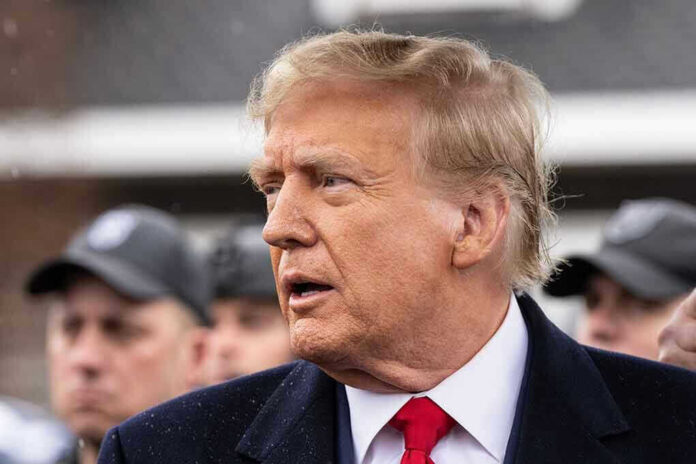
Amid a fog of wartime claims and viral clips, a fragmentary video of a BBC exchange with President Trump over an alleged Iranian girls’ school strike is fueling outrage—and raising hard questions about media responsibility and proof.
Story Snapshot
- A reposted clip shows President Trump reacting to a BBC-framed question about an Iranian girls’ school and U.S. strikes, but the full question is not preserved [1].
- Trump did not concede the premise; separate clips show him saying he did not know about the alleged school bombing and that officials were still investigating [2].
- Editorial framing on repost sites may exaggerate claims without primary transcripts or unedited pool footage [1].
- The absence of verified, incident-level sourcing invites caution before drawing conclusions about U.S. intent or responsibility [1][2].
What the available clip actually shows
A contemporaneous reposted video labeled as Trump responding to a question on an Iranian girls’ school strike displays on-screen text asserting he said the United States launched a bombing raid on Iran’s Kharg Island. The page is not an original broadcaster record, and it does not contain the full reporter question or the unedited exchange, limiting certainty about context and wording [1]. Because the source is a republished clip with minimal detail, the precise premise posed to the President remains unverified in this record [1].
Other circulating video snippets show Trump declining to affirm the school-bombing claim. In one short clip, when asked about an Iranian school, he replies, “I don’t know about that,” aligning with accounts that officials were still investigating rather than admitting U.S. culpability or intent. These pieces indicate the President did not accept the most inflammatory premise and kept attribution open pending verification [2]. Those statements counter headlines implying a confirmed admission.
Why fragmentary media can mislead audiences
Partial videos, added captions, and selective headlines can tilt perception during conflict reporting. The reposted page offers a sensational on-screen claim but no transcript, chain of sourcing, or proof that the BBC question accurately reflected verified facts on the ground. Without primary materials—such as the full BBC broadcast, the White House press pool feed, or an official transcript—viewers cannot evaluate whether the reporter’s premise was fair or whether the exchange was edited for effect [1]. This gap invites partisan narratives to fill in blanks.
For conservatives who have watched legacy outlets push rush-to-judgment stories before all the facts are in, this moment is familiar. The standard of proof must be higher than a caption or a viral clip. Responsible scrutiny requires documentable sourcing: the exact question, the uncut video, and incident-level evidence. When those elements are missing, claims about American intent or targeting—especially claims as grave as striking a school—should be treated as unconfirmed until independently verified [1][2]. Prudence protects both truth and America’s reputation.
How to separate verified facts from speculation
Readers should demand three things before accepting explosive wartime assertions: first, the verbatim question and answer from the original broadcaster; second, the complete, unedited footage establishing context; third, corroborating incident data from credible monitors. In this case, the available materials do not supply the BBC’s full wording, do not establish whether captions reflect what was actually said, and do not provide independent, incident-level confirmation tying the alleged strike to U.S. forces or intent at the time of questioning [1][2].
BREAKING: TRUMP CRASHES OUT ON BBC REPORTER FOR ASKING ABOUT US STRIKE ON MINAB GIRLS SCHOOL AT START OF IRAN WAR:
REPORTER: Admiral Cooper was asked yesterday about the strike on the girls' school
TRUMP: Well, it's under investigation
REPORTER: Are you able to confirm it was… pic.twitter.com/e9Hg3diJXe
— 𝐀𝐥𝐦𝐨𝐮𝐬𝐚𝐰𝐢_𝐇𝐐 (@Almuosavi_hq) May 15, 2026
Conservatives value accountability and truth over viral heat. The President’s on-camera posture—declining to accept the premise and noting ongoing investigation—tracks with that approach, rejecting hasty blame while facts are gathered [2]. Until primary records and credible investigations are public, sweeping judgments risk smearing U.S. service members, empowering adversary propaganda, and undermining constitutional oversight. The right response is disciplined skepticism: verify first, then judge, and hold media to the same evidentiary bar expected of government.
Sources:
[1] Web – Trump responds to question on Iranian girls’ school strike
[2] YouTube – Hegseth asked about bombed Iranian school, Trump reacts to new …