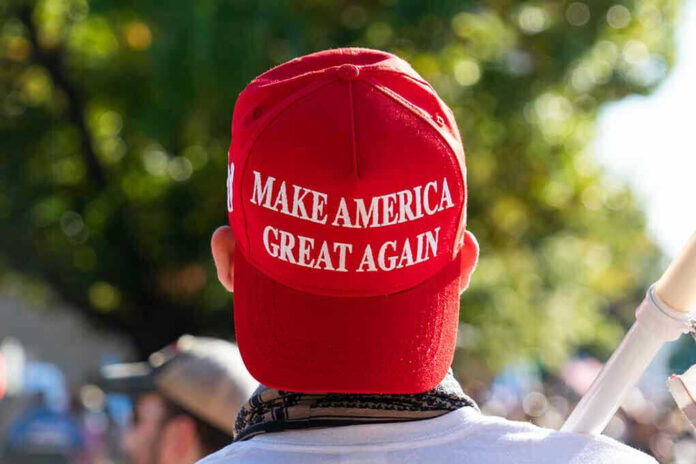
When nearly half of Trump’s own 2024 voters say “no thanks” to a 2028 comeback, the MAGA movement quietly crosses a line it never thought it would.
Story Snapshot
- Polls now show a large slice of Trump’s 2024 base balking at a third-term run in 2028.
- Term limits, exhaustion, and unmet expectations are starting to outweigh loyalty.
- Conservative voters are wrestling with whether the movement is bigger than one man.
- Both parties now face a post-Trump power struggle whether they admit it or not.
Trump Voters Are Quietly Drawing A Line
An Economist/YouGov poll reports that among voters who backed Donald Trump in 2024, 45 percent oppose him running for a third term in 2028. That number matters less as a horse-race stat and more as a cultural x-ray. A movement built on unwavering loyalty now shows clear signs of fatigue, boundary-setting, and what many conservatives would call simple constitutional common sense.
The same voters who tolerated chaos for the sake of policy wins now face diminishing returns. They watched two election cycles consumed by investigations, impeachments, and media warfare, while core promises on the border, spending, and the administrative state remained only partially fulfilled. When nearly half of those people say, “enough,” they are not turning left; they are asking whether repeating the exact same playbook will produce different results.
Term Limits, Constitution, And Grassroots Instincts
Most conservatives treat the two-term presidential limit as more than a technical rule; they view it as part of the cultural guardrail system that keeps ambitious men in check. Voters who supported Trump twice can still believe that pushing for a third term, even hypothetically or rhetorically, crosses a line from fighting the system to bending it. They may cheer his policies yet distrust any hint that the office should reshape itself around one personality.
That instinct lines up with long-standing conservative suspicion of strongman politics. The base largely rejects rule-by-bureaucrat, but it also resists rule-by-savior. For many Trump voters, the signal is not “abandon Trump,” but “protect the constitutional framework first.” When 45 percent decline a third-term idea, they broadcast a message to the Republican Party: keep the agenda, not the cult of personality.
Exhaustion, Backlash, And Diminishing Returns
Conservative voters over 40 have now spent two decades living through permanent political crisis: wars, financial collapse, Obamacare, riots, Russiagate, pandemic mandates, and prosecutions. Many accepted Trump as a necessary wrecking ball, not a permanent lifestyle. A third round of the same media hysteria, legal warfare, and street-level volatility feels less like courage and more like self-sabotage for families trying to live normal lives.
Practical conservatives look at swing-state suburbs, corporate HR departments, and public-school bureaucracies and see that Trump’s presence often hardens opposition rather than loosening it. They may still believe the system treated him unfairly, but they also see an entrenched backlash that costs them school-board races, corporate policy fights, and neighbors’ votes. At some point, a fighter becomes a foil, and voters start asking whether their movement needs a different messenger.
The MAGA Agenda Without The Trump Bottleneck
Republican voters who now hesitate about Trump 2028 often still support his core themes: border security, economic nationalism, judicial originalism, energy independence, and a humbler foreign policy. Their concern is not about the ideas but about the bottleneck effect. As long as every political question becomes a referendum on one man, the broader agenda struggles to grow, diversify, and institutionalize beyond his personality.
Poll Shows Even MAGA Voters Now Want to Dump Trump https://t.co/OtuXbKWW4w via @@YahooNews
— J Edwin6 (@JEdwin6) December 6, 2025
That is where traditional conservative values and common sense converge. A durable movement needs bench strength, succession planning, and ideas that survive any one leader. Voters signaling “no” on a third term might actually be trying to protect the MAGA policy package from burning out with its original messenger. They appear ready for candidates who can prosecute the same arguments with fewer personal vulnerabilities and fewer distractions.
What This Means For Both Parties Going Forward
Republican strategists now face a delicate problem: how to respect Trump’s base while opening the door to new standard-bearers. Any attempt to shove him aside will backfire, but ignoring that 45 percent warning sign risks losing winnable elections. The smart play, from a conservative standpoint, is to frame succession not as betrayal but as stewardship of the same goals by a new generation.
Democrats, meanwhile, cannot safely assume Trump will define their opponents forever. If a post-Trump Republican emerges who shares his populist instincts but lacks his personal baggage, the entire electoral map shifts. A base that still loves the policies but rejects a third term tells both parties that American voters want disruption with limits, strength with restraint, and change that still stays inside the constitutional rails.
Sources:
Trump’s Approval Rating Slips as Americans’ Economic Concerns Grow