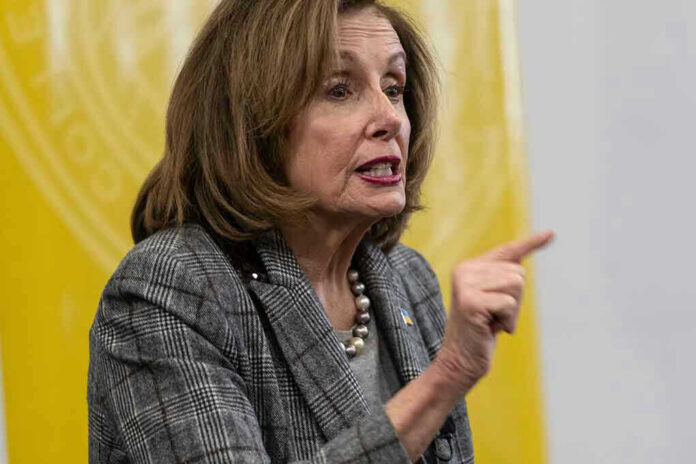
Trump’s response to Nancy Pelosi’s retirement didn’t just cross partisan lines—it bulldozed them, setting off a new round of political theater that left both admirers and critics scrambling for superlatives and soundbites.
Story Snapshot
- Donald Trump called Pelosi “an evil woman” and claimed her retirement was a “great service” to America.
- The announcement and Trump’s reaction reignited the fierce rivalry and polarized reactions from both parties.
- Partisan media and social platforms amplified Trump’s remarks as “epic,” revealing entrenched divisions.
- Pundits and political strategists are already gaming out the leadership shifts and long-term implications in Congress.
Trump’s Verbal Grenade Rocks the Retirement Stage
On November 6, 2025, Nancy Pelosi, the formidable and often polarizing former Speaker of the House, announced her retirement from Congress. Before the ink dried on the press releases, Donald Trump took the stage and unleashed a barrage that instantly ricocheted through every news feed and social media comment section. Calling Pelosi “an evil woman,” Trump offered no olive branch—only a declaration that her departure was a “great service” to the country. Partisan outlets seized on the moment, spinning Trump’s words as nothing short of “epic.”
Trump’s statement did more than just register as another headline; it set off a firestorm of commentary. Pro-Trump circles reveled in the takedown, framing it as long-overdue retribution for Pelosi’s role in his two impeachments and years of legislative trench warfare. On the flip side, mainstream and left-leaning voices decried the tone as further evidence of the corrosion of civility in American politics, warning that such rhetoric might make bipartisan cooperation an even more distant dream.
The Deep Roots of a Political Blood Feud
Trump and Pelosi’s rivalry is more than just political theater—it’s a saga with deep roots and high stakes. Pelosi’s tenure as Speaker saw her orchestrate the impeachment proceedings against Trump, champion progressive legislation, and frequently serve as his most visible foil. Trump, for his part, has made Pelosi a perennial target, casting her as emblematic of everything he and his base oppose. Their clashes—whether it was Pelosi tearing up Trump’s State of the Union speech or Trump’s Twitter tirades—have become iconic moments in modern American politics.
Both leaders have used their adversarial relationship to galvanize their respective bases. Pelosi’s willingness to confront Trump head-on earned her admiration from progressives, while Trump’s scorched-earth responses only deepened his support among conservatives. With Pelosi now stepping aside, Trump wasted no time framing her exit as a victory for his camp, a chance to reset the power dynamics in Washington.
Aftershocks: Congress, Media, and the Public React
Pelosi’s retirement is not merely a personnel change; it marks the end of an era for Democratic leadership and signals the start of a new scramble for influence. Democratic strategists are already assessing how to fill the vacuum and recalibrate for the 2026 midterms. Republicans, meanwhile, are eager to leverage Pelosi’s exit as evidence of a floundering opposition. Trump’s remarks, echoing loudly across cable news and digital platforms, have only intensified the spotlight on this transition.
Trump’s Response to Pelosi’s Retirement Was EPIC!https://t.co/6hlbEs5WPQ
— PJ Media (@PJMedia_com) November 6, 2025
The media’s role in amplifying the exchange cannot be overstated. Pro-Trump outlets have used the “epic” label with abandon, turning his words into rallying cries and memes. Mainstream news organizations have focused on the implications for Congressional decorum and the prospects for legislative progress. Social media’s response has been predictably polarized, with hashtags and hot takes multiplying by the minute.
What’s Next: Political Fallout and the Long View
The immediate impact of Trump’s outburst is a further ratcheting up of partisan rhetoric. Democratic leadership must now navigate a tricky transition, while Republicans sense opportunity to press their advantage. The broader public, meanwhile, is left to sift through the noise and decide what, if anything, has changed—a question complicated by the raw, personal nature of Trump’s attacks and the outsize role media amplification now plays in shaping political reality.
Long-term, Pelosi’s retirement and Trump’s response may serve as a blueprint for the next phase of American politics: more personal, more performative, and even less likely to result in genuine compromise. As the dust settles, both parties are recalibrating their strategies, and political consultants are already rewriting campaign scripts to reflect this latest flashpoint. For all the bombast, one thing is clear: the era of Trump vs. Pelosi may be ending, but its reverberations will define the next chapter in Washington’s ongoing drama.
Sources:
Trump calls Nancy Pelosi ‘evil woman’ after she announces retirement