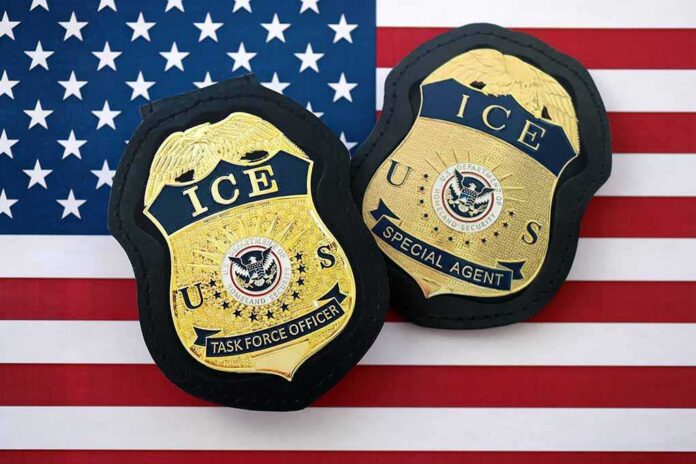
The Department of Homeland Security just rejected a federal watchdog’s plea to make Immigration and Customs Enforcement officers’ body cameras turn on by themselves, even though ICE’s own personnel admit manual switches get missed at the worst possible moments.
Quick Take
- DHS official Jeffrey Bobich said automatic activation risks exposing informants, victims, and protesters to unwanted recording during routine movement.
- The Government Accountability Office recommended automatic activation after finding ICE’s manual system leaves gaps in documentation and video evidence.
- ICE Directive 19010.3 already requires manual activation plus a 30-second pre-event recording buffer during enforcement actions.
- Congressional Democrats and recent reporting on shootings without activated cameras have intensified pressure on the agency’s stance.
Why DHS Says No to Automatic Cameras
Homeland Security gave the Government Accountability Office a specific answer, not a vague shrug. Jeffrey Bobich, the department’s executive director of financial management, warned that cameras switching on by themselves could catch sensitive moments with informants, victims, or people engaged in protected First Amendment activity. He called the privacy and operational risks greater than any benefit automatic activation might offer.
Bobich didn’t stop at general privacy worries. His written response flagged a narrower, more technical problem: cameras could fire off accidentally during ordinary movement, like walking through a building or riding in a vehicle, capturing footage nobody intended to record. That distinction matters because it frames the objection as a practical malfunction risk, not just philosophical discomfort with constant recording.
What the Watchdog Found Underneath the Policy
The Government Accountability Office didn’t just suggest automatic activation as a nice-to-have upgrade. Investigators found that without reliable activation controls, ICE risks real gaps in documentation and video evidence, the kind that make reviewing use-of-force incidents or misconduct complaints far harder. That’s not a hypothetical concern. It’s the agency’s own accountability tool failing to do its job when officers forget or hesitate to hit record.
Investigators also discovered something uncomfortable for ICE: most of its offices never wrote specific guidance telling officers when cameras should be on or off. That leaves the decision sitting entirely with individual agents in the heat of an encounter. The watchdog warned this gap raises the odds that required footage simply won’t exist when someone needs it most.
A Policy That Already Exists, Yet Still Falls Short
ICE isn’t starting from zero. Directive 19010.3, updated in September 2025, already tells officers to activate cameras when enforcement activity begins or as soon as it’s safe to do so. The policy even includes a built-in 30-second buffer that captures footage just before the button gets pushed. On paper, that sounds thorough. In practice, the Government Accountability Office’s findings suggest the paper and the practice don’t match.
That mismatch is the real tension here. ICE isn’t rejecting accountability as a concept; it has a written camera policy and a stated preference for careful, human-judgment activation. But when the watchdog says manual activation produces exactly the kind of documentation gaps it’s supposed to prevent, defending the status quo starts to look less like caution and more like avoidance of a fixable problem.
Political Pressure Keeps Building on Camera Transparency
Reporting on recent ICE shootings where officers reportedly had no activated body camera footage has sharpened public scrutiny of the agency’s position. That kind of story doesn’t require proving ICE did anything wrong in those specific incidents. It simply highlights the exact scenario the watchdog warned about: missing video when the public most wants answers.
NEW: A federal watchdog says gaps in ICE and CBP’s body-camera programs increase the risk that encounters required to be recorded could go unrecorded.
The GAO report, publicly released today, finds:
• Most CBP and ICE offices lack specific operational guidance explaining when…
— Ali Bradley (@AliBradleyTV) October 14, 2026
Senate Democrats have used moments like budget negotiations to push for mandatory body cameras and an end to masked, unidentified agents during operations. Meanwhile, ICE has said it can withhold footage when release might compromise an investigation or someone’s privacy, a reasonable safeguard on its face, but one that keeps the agency holding both the record button and the release decision. For an agency trying to rebuild public trust, that combination deserves a harder look than a one-line rejection letter gives it.
Sources:
washingtontimes.com, news.bloomberglaw.com, ground.news, washingtonpost.com, ice.gov
© targetdailynews.com 2026. All rights reserved.